
John William Hodkinson's working life, and death (1942)
John William Hodkinson's birth (1869), marriage (1896) and trip to Australia (1911)
John William Hodkinson's working life, and death (1942) ... this page
John William Hodkinson's three times in the army
John William Hodkinson's eighteen homes
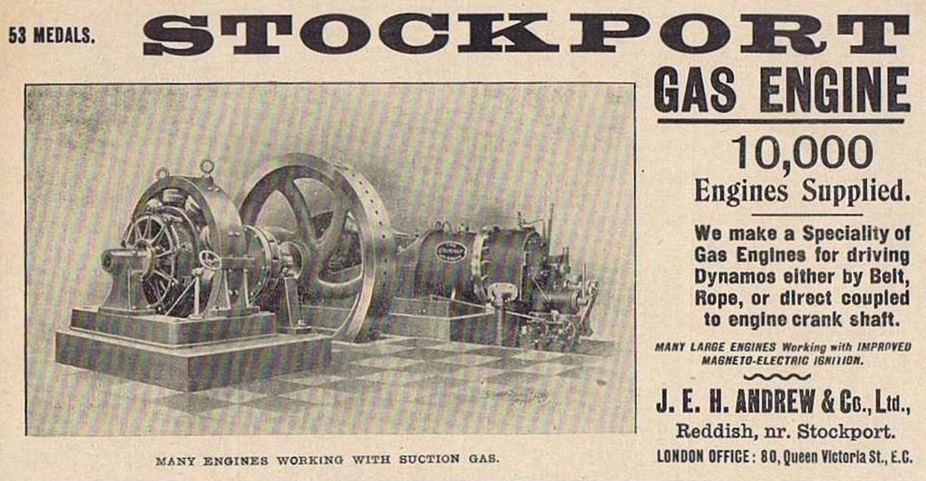
John William Hodkinson worked at the Gas Engine Works in Reddish from about 1900 to about 1911
- Parents: James Hodkinson and Sarah Ellen Hodkinson (remarried as Kenyon)
- Born: Monday, 20th September 1869
- Married: Saturday, 4th April 1896 (age 26 years and 6 months)
- Four children: all boys
- Died: Monday, 2nd February 1942 (age 72 years and 4 months)
What a difference a generation can make
Life as a child had been tough for John William Hodkinson. He had experienced grinding poverty in a variety of homes in Ashton-under-Lyne. He had to come to terms with the deaths of five brothers and sisters and of his father by the time he was 20 years old. He had to adjust to new family relationships when his mother remarried and had children with her second husband.
The effect of all of this on John William could have been profoundly negative, but it wasn’t. He grew up to be a determined and resourceful individual who did not give up easily in the face of challenges. From the age of eleven, his stepfather (George Albert Kenyon) was a positive influence and encouraged him to become a core maker, skilled work which earned him a good salary and status. John William’s regard for his stepfather was reflected in naming his first son after him, but none of his children (all boys) were given the name of his natural father (James), either as a first or second name.
John William Hodkinson’s social standing was also indicated by his right to vote. Prior to 1918, it was necessary to own a property or pay rent above a designated amount in order to be allowed to vote. In the case of John William, it was the latter criterion which came into play and which accounts for his name on local electoral registers more or less from the time that he was married.
Marriage was the start of a new era for John William. Yet, although happily married with Frances Eliza, he could not shake off tragedies. Vincent Hodkinson, their second child died in 1899, not having reached the age of three months. Their first son died in 1918, a soldier of the Great War. John William Hodkinson may well have been resilient, but he struggled with ill-health. Deafness, vertigo and rheumatism – probably due to his working environment – started to have a major impact well before he was forty. An army medical report of 1917 states that John William had been laid up for six months before enlistment due to (in John William’s own words) “paralysis of the brain”. His health continued to deteriorate particularly badly in the 1920s and the 1930s, necessitating long stays in hospital and, ultimately, leading to his death.
John William Hodkinson at work
Although he worked as a weaver at a young age, John William, with the encouragement of his stepfather George Albert Kenyon, completed an apprenticeship as a core maker, an occupation that he stayed with for the rest of his working life. During the First World War he spent two short periods in the army, but in unskilled roles.
1881: John William, 11 years old, half-time weaver
John William was 11 years and seven months old and was living at 1 Headfield Street, Ashton-under-Lyne when the census was taken at the start of April 1881. Although he was well over a year into his working life, legislation determined that those who were between 10 and 13 were to work half-time only. On those days or half-days when he didn’t work, John William had to attend school.
Where he worked half time will never be known, but he probably worked near his Headfield Street home in one of the many local cotton factories. Maybe he worked at Junction Mills – if he went out of the front door, and crossed Whittington Street, he would be at the entrance.
c.1883-c.1890: John William, 14 to 21 years of age, seven years as an apprentice
When John William reached the age of 14, the combination of half-time working and part-time elementary education was over for ever. Changes in his working life now took place, which would be life changing.
John William’s dad died in 1881 and his mum married again in 1882, to a widower, George Albert Kenyon. George Albert Kenyon worked in the iron industry in various overlapping roles, which included iron moulder (his first job), furnaceman, tip maker and shuttle tongue forger. George Albert’s dad was an iron moulder, and it is not surprising that George Albert himself followed in his dad’s footsteps.
They both knew from experience that the apprentice route to being an iron moulder, although not well paid and which could take seven years, was one that, in the long term, was a very good choice for, in the hierarchy of working-class jobs, an iron moulder had good status, and was paid well. That being so, it is also not surprising that George Albert’s new stepson, John William, was persuaded, or encouraged, or told, to take on a similar apprenticeship: that of core maker. This changed his life in a positive way – when he finished his apprenticeship, he, like his stepfather and step grandfather, had a good job with good pay and was able to provide a decent standard of living for his family.
c.1883-c.1890: John William, 14 to 21 years of age, seven years as an apprentice ... what a life!
At the heart of a typical apprenticeship was a legally binding indenture between parents, apprentice and a master. A master might be a business or a highly skilled self-employed individual who owned his own workshop and who was legally allowed to train others. In return for learning all aspects of a trade, the apprentice had to do as he was told by his master, not to do any damage to his master’s reputation, and, as the fairly modern phrase goes, to have his back. Additionally, the apprentice was not to pass on any secrets (an early form of a non-disclosure agreement?!), and not to waste resources, or to lend them to others.
That, and some other related terms, covered the long and tiring work day, but after work … the apprentice was not to have sex, not to get married, not frequent alehouses and taverns, not to play cards or dice or participate in unlawful games where his master might suffer loss. In theory, the indenture meant a great deal of control over an apprentice’s life at work, and of whatever leisure time he had. In practice, control of leisure time and some aspects of work life would have been impossible to police. What did John William get up to?! If only we knew! He certainly did not get on the wrong side of his master (well, maybe he did occasionally!) for, whatever the terms and conditions of the indenture, John William successfully completed his apprenticeship.
1891 onwards: John William, from core maker to journeyman core maker
In April 1891, John William was 21 years and seven months old and his stepfather would have taken great pride in filling in the ten-yearly census form for he could write “core maker” next to John William’s name. John William also would have felt proud to see his occupation written on an official government form, a huge milestone in his life after seven long years as an apprentice.
In 1891, John William, however, was at the start of his career, and, as his skills improved and were honed over subsequent years, he gained the status of “journeyman” with extra pay and status which reflected the quality of his work. That is why on the birth certificates of two of his children, both born at the same address in 1897 and 1899, his occupation is given as core maker (journeyman), although he may have acquired that status well before the birth of the two children. Once he had proved how good he was, either at work or on official forms, he dropped the “journeyman” part of his role, as was common practice, and was quite happy to be known as a core maker. He was undoubtedly very skilled at his work, as he spent the next ten years or so at an engineering works.
About 1901 - October 1911: John William, 31 to 42 years of age, working at the J.E.H. Andrew gas engine works in Reddish
An engineering works in modern premises and at the forefront of modern engine technology – that was J. E. H. Andrew and Company Limited of Reddish, established in 1878 and absorbed by R. Hornsby and Sons of Grantham in 1906 … and John William found employment there! He must have been so pleased that his skills were recognised and were wanted in the factory and that he would be working in an environment that would have been far better than any he had experienced so far.
Using the censuses of 1901 and 1911, electoral registers and other official documents, it seems a strong probability that he spent more than ten years in the same workplace from before the 1901 census until he left for Australia in October 1911.
A core maker's dream? This 1904 Stockport Gas Engine advert for J.E.H. Andrews in Reddish shows the kind of engine that John William would have helped to make.
An article in the Iron and Steel Journal of 1899 commented that the works
... are of considerable size, are situate adjoining the London and North-Western Railway Station, Reddish, ten minutes’ walk from Reddish Great Central Railway Station, and a quarter of an hour’s walk from Heaton Chapel Station, London and North-Western Railway. The works are devoted solely to the manufacture of Stockport gas-engines, in sizes from 1 horse-power to 250 horse-power. The factory is driven by gas-engines worked from fuel-gas made on the premises … The works contain many examples of the most modern tools and labour-saving appliances, including electric travelling cranes. They are lighted throughout by the electric light, and are capable of turning out about 16 gas-engines per week.1
From about 1903 to 1906, John William lived at 4 Hurst Street in Reddish – a very convenient short walk away from the factory site next to the railway station. When his family moved to Stockport, he continued working at the same place – it wasn't that far away, just about three miles.
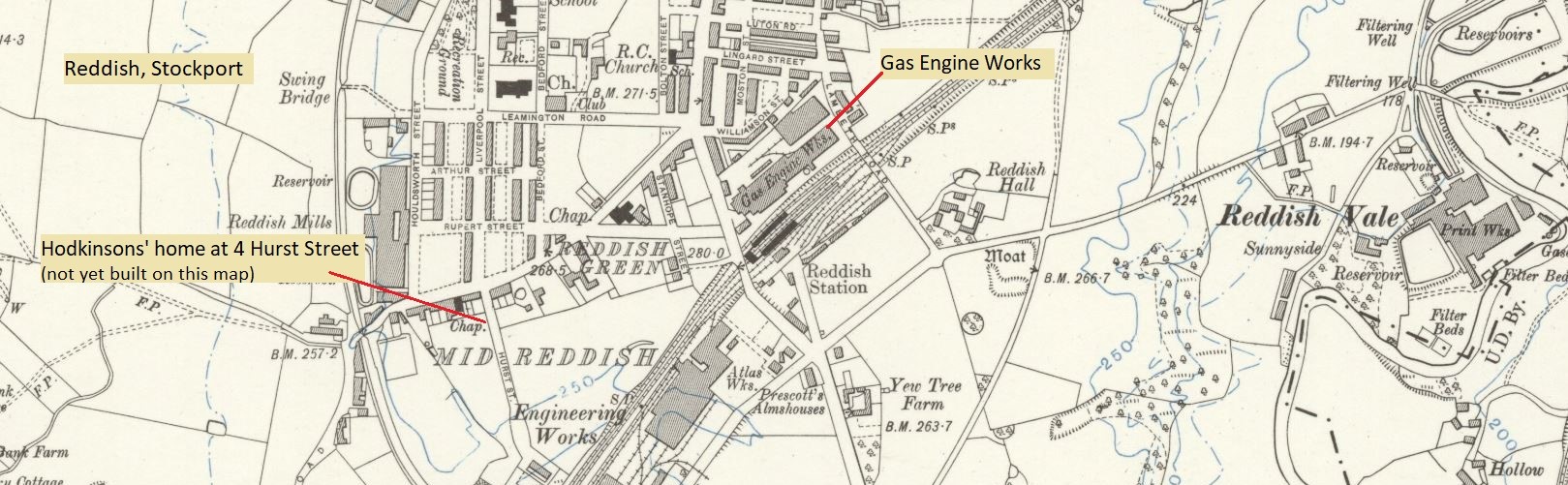
John William Hodkinson's home was conveniently situated for a short walk to his work at the gas engine factory. The Lancashire part of this map, which includes Reddish, was revised in 1904-05, but does not show the house at 4 Hurst Street where the Hodkinsons lived from at least July 1903 to at least June 1906. The map was published in 1911 and is reproduced with permission of the National Library of Scotland.
Since the Gas Engine Works was the first named factory where John William worked, I did a mild in-depth search of local newspapers published from 1900-1911 (which roughly covers the years that John William was employed at the Gas Engine Works) to see if there was anything of interest which related to the factory. There was – and the items below, I think, give a good “feel” of John William’s working environment.
The best place to start is with something nice ... a picnic.
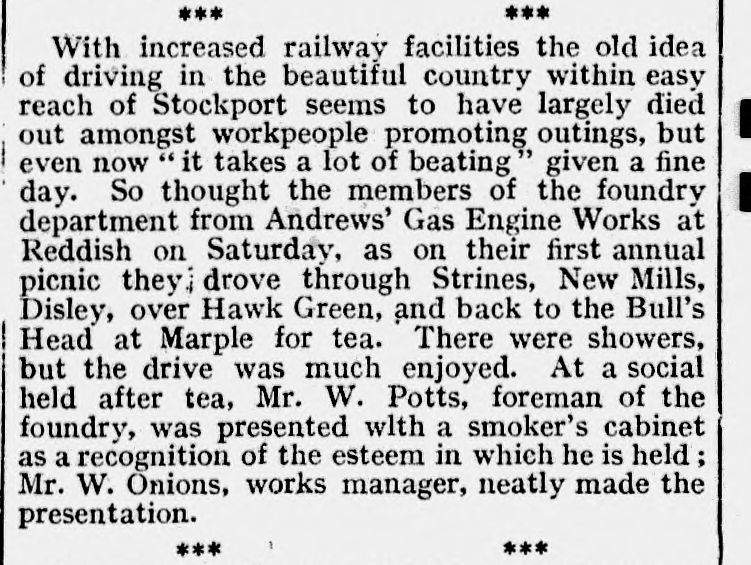
There’s nothing better than going on a works’ outing on a day off. On 14th September 1905, the Stockport County Express published an item about the foundry workers at the Gas Engine Works having their first annual picnic. I have no doubt at all that John William took part in that little soiree. From the report, it looks as though the outing was for foundry employees only, so, unlike other similar works' outings, there would have been no family members taking part.
Although the newspaper said it was the first picnic, I could find no further mentions of similar events for the foundry workers when I searched through local newspapers for the next six years. Either the events were never mentioned again in the press, or the first picnic was the last.

John William joined J.E.H. Andrew and Co. Ltd in or around 1900, at a time when the company was embroiled in a legal dispute over a 1890 patent which had been granted to Frederick Lanchester and which detailed a safer way to start large gas engines. The British Motor Company and the Great Horseless Carriage Company, which held rights under Lanchester's patent said that J.E.H. Andrew had infringed the patent. The issue went to court and Mr Justice Kekewich dismissed the case. The Court of Appeal then reversed that decision. The case moved to the House of Lords (the Appellate Committee of the House of Lords which functioned like a supreme court) which re-instated the original judgement of Mr Justice Kekewich on 17th December 1900. J.E.H. Andrew and Co. Ltd had won (with costs) – a great Christmas present! On 21st December 1900, the Stockport Advertiser and Guardian reported on the outcome of the case. Clicking/swiping on the image will produce a larger version.

Serious accidents occurred at the Gas Engine Works, some of which resulted in death, of which more later. However, the factory took safety issues seriously, as illustrated from this item in the 21st August 1908 edition of the Stockport Advertiser and Guardian. In the extract from the article which follows, the word "ambulance" refers to first aid, and the competition mentioned would have involved simulated accidents, application of first aid, stretcher drills, and so on. Workers could bring their families to watch the competition, and, doubtless, John William and wife Eliza and their three sons were there to watch.
The second ambulance competition in connection with Hornsby's Gas Engine Works at Reddish is to take place to-morrow (Saturday) in the packing department, a cordial invitation having been extended to workmen and their families. Dr. G. Ashton, of Fallowfield, is to be the judge, assisted by Dr. Christian, of Stockport, the tutor of the class. Four teams, with five men in each, are to compete, and medallions are to be presented to the members of the winning team. A special medallion is also to be given by Dr. Christian to the competitor who obtains the highest number of points in the competition.
The article went on to bring attention to the death of a fitter at a factory in Stockport whose life, the Coroner felt, may have been saved if there had been an "ambulance corps" at his works. The sad reality was that there was nobody at all with any kind of first aid training who could have helped the fitter after he was badly injured in an explosion.
In my non-exhaustive search in local newspapers for articles about the Gas Engine Works, I came across two reports about serious accidents at the factory which resulted in deaths.

The Stockport County Express of 14th November 1900 reported the case of Sam Booth, an employee of the works, who was found dead, lying face down in several inches of water at the bottom of an 8ft siphon pit which served a mains gas pipe. The coroner’s inquiry revealed that Booth had been looking after the siphon for two weeks, but it was not something that he usually did. The coroner was told about a tap on the pipe that had broken off, leaving a quarter inch hole through which gas could escape. The newspaper article reported further that
W. Spink, a surgeon, practising in Reddish said he was called to see deceased on Friday morning about 8 45. … On opening the body he and Dr. Smith could distinctly smell gas, so much so that they had to leave the room for a few minutes. … His opinion was that death was consequent upon the inhalation of a gas which contained, among other constituents, carbon monoxide. … Several jurymen said the deceased was incompetent, but the Coroner remarked that he should not have taken on the work if he was incompetent. The jury returned a verdict of "Death from misadventure, caused by the inhalation of a quantity of gas containing carbon monoxide."

In 1905, another accident resulted in a death and the serious injury of a second person. Two iron crane girders were being unloaded from separate lorries at the Gas Engine Works. One of the girders, which weighed 3 tons and 9 cwt (7728 lbs – over 3,500 kg), “heeled over” and instantly killed James Sharratt (aka Hamilton) who had being working at the factory for just a week. The foreman from the company which was responsible for erecting the crane was supervising the work and was severely injured when he was hit by the second girder. The coroner’s inquiry into the accidents was told that the foreman had “considerable experience” in the erection of cranes. The coroner’s view on that was to quote the proverb that familiarity breeds contempt. The Stockport County Express published the article about the accidents on 5th May 1904.
Other news items mention two more deaths but not related to safety issues at the factory. Leaving aside the sadness of a death, the first article, published in the Stockport Chronicle on 9th April 1902, is interesting in that it provides some details of the daily routine of a worker at Gas Engine Works.
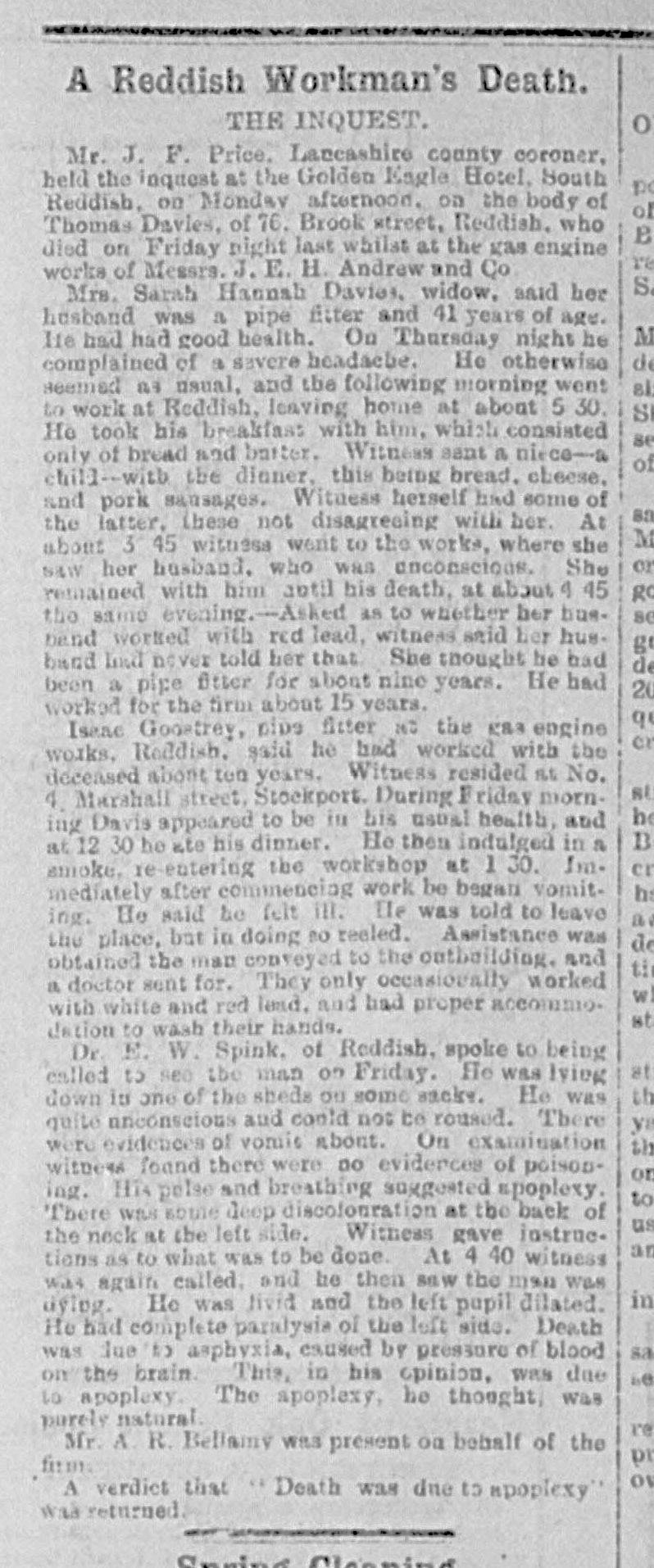
Thomas Davies, age 41 and a fitter at the Gas Engine Works, complained to his wife on Thursday evening, 3rd April 1902, of having a headache. The following morning, he seemed fine and left for work at 5.30, taking his breakfast of bread and butter with him. His wife sent a niece (a child) with his dinner (i.e. lunch) of bread, cheese and pork, which he ate at 12.30, followed by a smoke. He was back at his workshop at 1.30, where he said he felt ill and began vomiting. He was told to leave the workshop, but “reeled” and had to be helped to an outbuilding where he lay down on some sacks. His wife and a doctor were called. The wife remained with her husband who was unconscious when she arrived at 3.45; she stayed with him until his death one hour later. The doctor was also present at his death and, based on his observations, the coroner at the inquest on the following Monday returned a verdict that death was due to apoplexy (essentially a stroke).
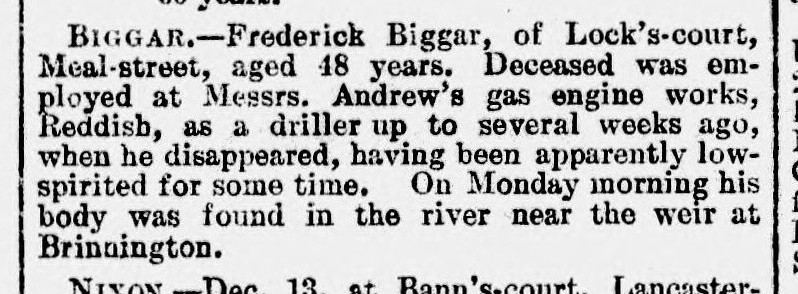
This is another 1902 newspaper report, from the Stockport County Express of 18th December, which is self-explanatory and reads:
BIGGAR.— Frederick Biggar, of Lock's-court, Meal-street, aged 18 years. Deceased was employed at Messrs. Andrew's gas engine works, Reddish, as a driller up to several weeks ago, when he disappeared, having been apparently low-spirited for some time. On Monday morning his body was found in the river near the weir at Brinnington.
The gossip network at the Gas Engine Works would have been on fire with muttering, grumbling, speculation, information and misinformation which surrounded the events detailed above. It is hard to believe that John William did not put his two penn’orth in, as that delightful, but outdated, phrase goes. Around 1911, there were bigger things on John William's mind, especially a trip to Australia.
October 1911 to an unknown date not later than October 1914: John William, from 42 to 45 years of age, working in Melbourne
John William's journey to Melbourne, and his reasons for going there, is on a separate page.
When in Melbourne – for an unknown length of time – he most likely continued to work as a core maker or a moulder.
October 1914 to April 1915 and May to October 1917: John William, from 45 to 47 years of age, soldier
A full account of John William's time in the army is on a separate page.
As a very, very brief summary, he served as a private in the 3rd (Special Reserve) Battalion, the Cheshire Regiment, from October 1914 to April 1915 when he was discharged on medical grounds. Surprisingly, he rejoined the army and was allocated a role as a labourer in the 331st Road Construction Company of the Corps of the Royal Engineers, from May 1917 to October 1917, when he was again discharged on medical grounds.
1921: John William, age 51 at census date, employed at Henry Hollingdrake and Son, Iron Founders, Stockport
Although we know about John William’s trip to Australia in 1911 and his service in the British Army during 1914-1915 and 1917, what is no longer known is where he worked between, and immediately after those events. However, the census of 1921 reveals that John William Hodkinson was working at Henry Hollingdrake and Son, Iron Founders, 65 Prince’s Street, Stockport, as a core maker. Did he get employment there in 1917 after leaving the army?

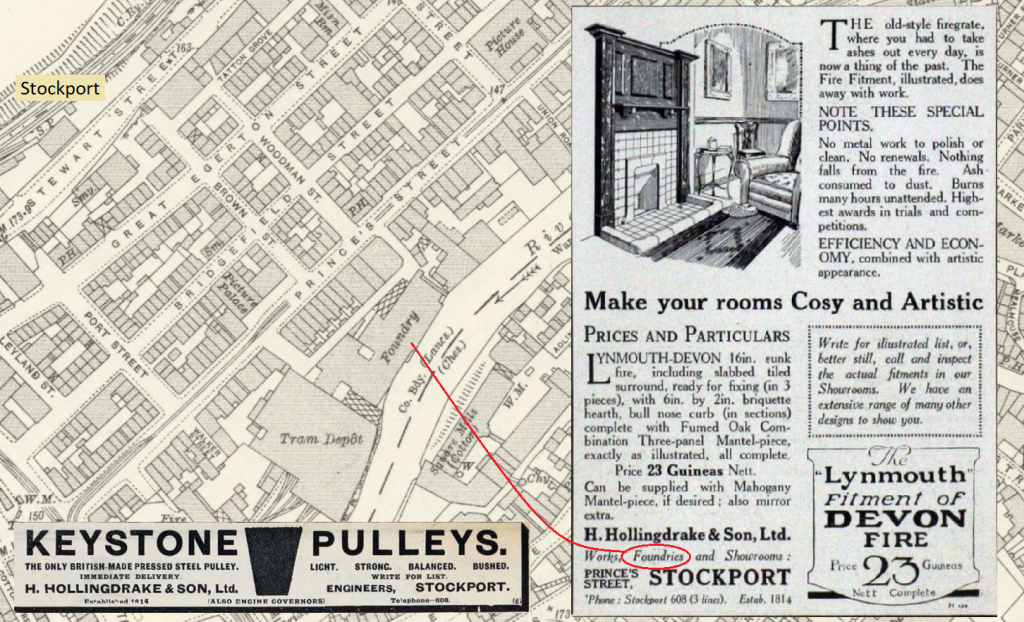
The listing above is from Kelly’s 1914 directory for Cheshire. H.Hollingdrake and Son Limited was founded a hundred years earlier and was still thriving, having successfully adapted its business practices to take advantage of the massive changes in commerce and industry over a century. As seen from the listing and the adverts from 1919 and 1921 (Acknowledgements to Grace's Guide2), the company’s portfolio was diverse. The map, which has a revised date of 1917, shows the location of the foundry where John William worked. The map has been reproduced with the permission of the National Library of Scotland.
1921-1942: John William, 51 to 72 years of age, battles illness
There is no recorded information about where John William was employed from 1921 when he worked at Hollingdrake's to his compulsory retirement age of 65 in 1934. Becoming a core moulder may well have changed his life for the better in terms of pay and a related lifestyle, but his occupation changed his life for the worse in other ways. He was discharged twice from the army on medical grounds and his army records show he suffered from rheumatism, deafness and vertigo, doubtless the result of working conditions in his job as a core maker. In the 1920s and up to his death, snippets of information in a Hodkinson diary indicate that John William was often very ill and spent time in hospital, so the last thirteen years of his working life were punctuated by periods – some of them long – when he did not work at all.
John William's jobs as a core maker and moulder - praiseworthy occupations
As a final few paragraphs about the working life of John William, it's nice to look at something positive, namely some contemporary occupation-specific writings about what others thought about the kind of job he had.
In 1887, when John William was getting towards the end of his apprenticeship, an article about a locomotive foundry commented that "... mouldings of all sizes and shapes are being made ... over which the moulder expends as much care and pains as if he were a sculptor at work upon some tender piece of statuary."3
In 1902, when John William was working at the gas engine factory in Reddish, the author of a book on modern iron foundry practice wrote, "Of the many branches of the engineering trade, there are few which offer such scope for the exercise of mental power and perceptive faculty as the construction of a mould ... and a careful study of the moulder’s art by the pattern maker and draughtsman is essential if thoroughly satisfactory work ... is to be produced."4
A 1921 book entitled Iron Founding spoke of "... the success or otherwise in dealing with (castings) ... depends entirely on the individuality of the moulder, and readiness in dealing with problems … is one of the attributes of a skilful moulder."5
In 1922, an article specifically about core makers which was published in The Foundry Trade Journal commented that the degree of skill necessary in the making of cores was not less than that required in the preparation of moulds and went on to point out that the making and assembly of cores for highly complicated work was more difficult than the preparation of moulds.6
The chances are that John William never read any of the compliments above, but he knew his job was skilled and respected and was well placed in the hierarchy of working-class jobs.
The death of John William Hodkinson on Monday, 2nd February 1942, age 72 and four months
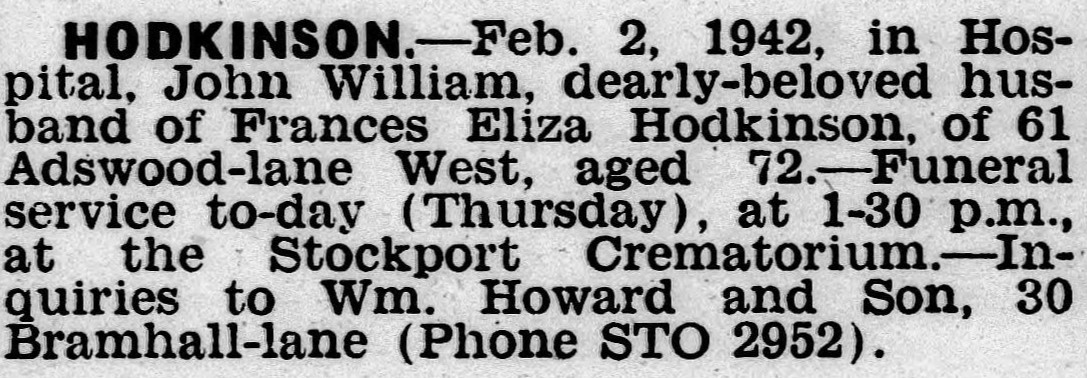
Information about John William's funeral arrangements was published in the Stockport County Express on Thursday, 5th September 1942. John William had been unwell for many years and spent long spells in hospital.
As John William's health deteriorated after the war, he became a frequent visitor to the infirmary at the workhouse in Stockport. Some of the stays were long, with, for example, a family diary detailing such a visit in 1926. The 1939 Register also shows that he was in the workhouse at the time that the Register was taken. John William struggled on with ill health until Monday, 2nd February 1942 when he died. He was 72 years and four months old. His wife, Frances Eliza, was with him in his final moments. Three days later, on Thursday, 5th February, his funeral service was held at Stockport Crematorium, with this information being published on the same day in the Stockport County Borough Express, as above.
The causes of John William's death
On John William's death certificate, Dr William More provided three related causes for his death.
The first was bronchopneumonia, which is a bacterial lung infection. The risk factors for developing such a condition relevant to John William appear to have been his age, his history of smoking and, bearing in mind that his death occurred in winter, perhaps recent respiratory infections, such as influenza, also had a part to play. Added to that, he had spent a lifetime of breathing in silica dust in his workplaces and the consequences of that – silicosis and lung scarring – would have permanently hindered the ability of his lungs to function normally.
The chest infections contributed to the cause of the second stated reason for death, namely, myocarditis, the inflammation of the heart muscle.
Sadly, John William’s heart had been in a bad way for some time. His age, smoking and probably a high-fat diet were the factors in his life that brought about arteriosclerosis – the thickening and hardening of arterial walls – which was the third reason given for his death. However, it needs to be kept in mind that the term arteriosclerosis was often used in a broader sense, and could cover other aspects of heart disease which may have affected John William.
Compared to current medical research and practice, the knowledge and understanding of the harmful effects of a poor diet and of the dangers of smoking were at a basic or non-existent level when John William died. This is amply illustrated by a story passed down the generations relating to John William’s love of pipe smoking. When he put sugar in his tea, he often stirred it, not with a teaspoon, but with the stem of his pipe. This meant that the highly concentrated nicotine and tar residues inside the stem dissolved directly into his hot tea … and then he drank it! The effects on his bad heart would have been to cause narrow blood vessels to constrict more, and the effects on his blood pressure would have been detrimental. John William would have enjoyed sitting and having a nice cup o’ tea, but he, unwittingly, was enjoying a nasty cup of toxicants and adding to his heart problems and the causes of his death.
John William Hodkinson's family after his death
John William was survived by his wife and two of his four children.
His wife, Frances Eliza Hodkinson, was 69 years old when John William died.
Frances Eliza Farrar was born in a house in the High Street, Kidsgrove, Staffordshire, on 12th February 1872. By 1881, her family were living in Dukinfield with the census of that year stating that she was a scholar. Ten years later, the 1891 census gives her occupation as a cardroom hand; her 1896 marriage certificate and the censuses of 1901 and 1911 provide no information about her occupation; she is performing “Home Duties” in the 1921 census; and, according to the 1939 Register, she is carrying out “unpaid Domestic Duties” in that year. Frances died on 3rd August 1949 at 61 Adswood Lane, Stockport, the house that she and her family moved into in 1911.
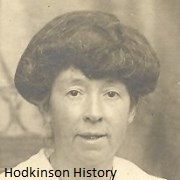
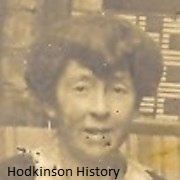
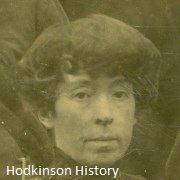
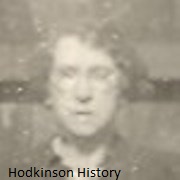
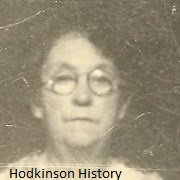
As the years go by ... the images of Frances Eliza Hodkinson (Farrar) are cropped from undated photographs from about the 1890s to the 1940s. (Photographs: property of Samuel Hodkinson.)
John William's first son, George Albert, died in 1918 of war wounds. His second son, Vincent, died in 1899 from bronchopneumonia.
John William's third son, John Hodkinson, was 41 years old and living in Portwood with his wife when his dad died. World War II was into its third year but John, as an x-ray machine operator, was exempt from military service. However, he supported the war effort as a volunteer part-time ARP (Air Raid Precautions) warden. John Hodkinson died in 1971 and his wife died in 1993. They had no children.
Steven Hodkinson (whose life I am currently researching) was working on wing construction for military aircraft at the Fairey Aviation company in Errwood Park, Stockport.
John William Hodkinson's birth (1869), marriage (1896) and trip to Australia (1911)
John William Hodkinson's working life, and death (1942) ... this page
John William Hodkinson's three times in the army
John William Hodkinson's eighteen homes
Bottom of the page information
Notes and sources for this page:
Unless otherwise mentioned, this page is based on copies of birth, marriage and death certificates; census returns; and family documents and related items including photographs which are the property of Samuel Hodkinson.
- Brough, Bennett H (ed.), The Journal of the Iron and Steel Institute. (London: E & F.N.Spon Limited. 1899.) p.272.
- Grace’s Guide, H. Hollingdrake and Son. (https://www.gracesguide.co.uk/H._Hollingdrake_and_Son. 10th June 2022.)
- Various Writers, Fortunes Made in Business. (London: Sampson Low, Marston, Searle and Rivington. 1887.) p.358.
- Bale, G.R., Modern Iron Foundry Practice. (Manchester: The Technical Publishing Co. Ltd. 1902.) p.2.
- B.Whiteley, Iron Founding. (London: Sir Isaac Pitman and Sons Ltd. 1921.) p.54.
- Shaw, Ben and Edgar, James. Cores and Core Making. Foundry Trade Journal. (London. 9 November 1922.) Vol 26, no. 325. p.389.
Date of the latest updates
This page was originally published on 12th August 2018. The latest updates were completed by Monday, 13th July 2026.