
John William Hodkinson's birth (1869), marriage (1896) and trip to Australia (1911)
John William Hodkinson's birth (1869), marriage (1896) and trip to Australia (1911) ... this page
John William Hodkinson: 1896-1942 – marriage to death
John William Hodkinson: 1900-1917 – three times a soldier
John William Hodkinson: 1869-1942 – eighteen homes
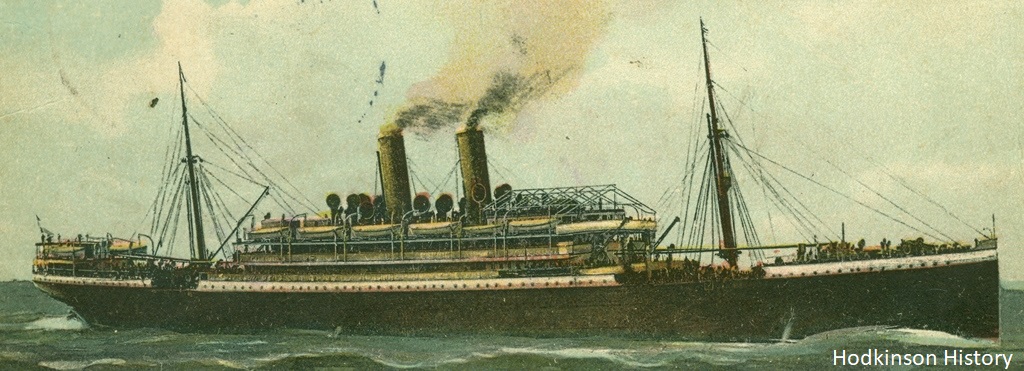
This is the SS Konigin Luise which took John William Hodkinson to Australia.
- Parents: James Hodkinson and Sarah Ellen Hodkinson (remarried as Kenyon)
- Born: Monday, 20th September 1869
- Married: Saturday, 4th April 1896 (age 26 years and 6 months)
- Four children: all boys
- Died: Monday, 2nd February 1942 (age 72 years and 4 months)
The birth of John William Hodkinson in 1869
John William Hodkinson1 was born in a small, terraced house at 185 Church Street, Ashton-under-Lyne on 20th September 1869. By the time he was 12, his dad and four of his siblings were dead, with poverty and slum living playing a major part in their fates.
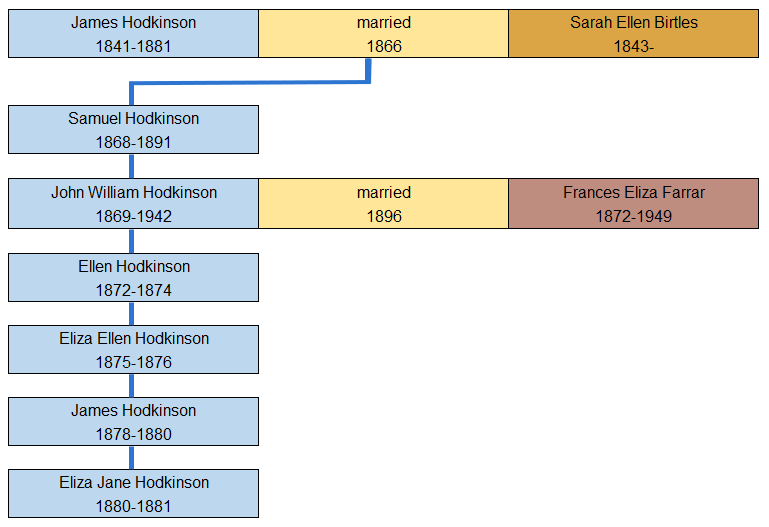
John William was the second child born to James Hodkinson and Sarah Ellen Birtles.
Samuel and John William Hodkinson's education and family in Ashton-under-Lyne
For John William and his brother Samuel, life showed some improvement in 1878 when central government initiatives meant that the two would work less hours and would receive an education. However, what really had a positive impact was when widow Sarah Ellen Hodkinson made a good choice in marrying widower George Albert Kenyon in August 1882, after the death of her husband in February in 1881. George was an iron moulder, a job with status and a good wage which placed the new Hodkinson/Kenyon family in a much better financial position and which meant they could enjoy better living conditions.
The education of Samuel and John William Hodkinson
In terms of education and work, both boys had not reached their teenage years when significant laws came into force which had a major bearing on their schooling and on their working lives. In particular, under the provisions of the Factory and Workshops Act of 1878, children who were between 10 and 13 (for Samuel, this meant March 1878 to March 1881 and, for John William, this meant September 1879 to September 1882) were to work half-time only. There was the added requirement that a parent of "a child employed in a factory or workshop shall cause that child to attend some recognized efficient school" on those days or half-days when the child was not working. A child who reached a certain number of attendances or attained certain standards in reading, writing and arithmetic by age 13 was awarded a certificate of proficiency and, with that certificate, the child was deemed to be a young person.
Maybe the two Hodkinson boys weren't awarded certificates. Maybe they were. Maybe attainment was the deciding factor, which would have been measured by Standard 4 of the Code of 1876. To reach that level, they would have been able to "read with intelligence" a few lines of prose selected by an inspector; to write eight lines slowly dictated once from a reading book; to show improved handwriting in their copy books; and as far as arithmetic was concerned, they would have been able to do sums involving compound rules in money and do reduction workings for weights and measures. Certainly, the evidence from John William's later life shows that he could have attained those standards as a child; probably the same was true for Samuel. I like to think that was the case and that Samuel and John William were the first Hodkinsons in my family to be awarded school certificates.
More about the life of Samuel Hodkinson is here.
Dad James Hodkinson dies and a new family structure takes shape
James Hodkinson died in February 1881. He was 39. At the time of his death, he had three surviving children: his oldest son, Samuel, was twelve; his second-oldest son, John William, was eleven; and his only surviving daughter, Eliza Jane, was five months old. Sadly, Eliza Jane would only live for another few months. With James Hodkinson, the highest earner of the family, no longer alive, widow Sarah Ellen Hodkinson knew that life was going to be a lot tougher than it had ever been during her marriage.
Sarah Ellen knew she had to move on quickly with her life and find a new husband. This was often the case with those recently widowed since economic necessity dictated the need for action. A new husband or the workhouse – the choice was not hard to make. As mentioned earlier, she married a widower, George Albert Kenyon. The ceremony took place in August 1882 at the Parish Church of St Michael and All Angels in Ashton-under-Lyne, with the new Mrs Kenyon about three months pregnant.
By February 1883, the Hodkinson/Kenyon family had moved to 61 Park Street in Ashton-under-Lyne. Sarah Ellen Kenyon had two children at this address – James Henry Kenyon and Hannah Kenyon. Of her six Hodkinson children, only two were alive – Samuel Hodkinson and John William Hodkinson. In 1891, Samuel died; that left John William as the only survivor of his branch of the Hodkinson family. However, his prospects were looking good. A successful apprenticeship as an iron moulder (doubtless with the encouragement of his stepdad, who was also an iron moulder) set him in good stead for his future life with a job with status and a good wage. It wouldn't be too long before he married and a new generation of Hodkinsons would be born.
John William Hodkinson from his birth in 1869 to his marriage in 1896: key events
This is a list of key family events in John William's life.
- 1872: birth of Ellen Hodkinson, his first sister;
- 1874: death of Ellen Hodkinson;
- 1875: birth of Eliza Ellen Hodkinson, his second sister;
- 1876: death of Eliza Ellen Hodkinson;
- 1878: birth of James Hodkinson, his second brother;
- 1880: death of James Hodkinson;
- 1880: birth of Eliza Jane Hodkinson, his third sister;
- 1881: death of James Hodkinson, father;
- 1881: death of Eliza Jane Hodkinson;
- 1882: marriage of his mother, Sarah Ellen Hodkinson, to George Albert Kenyon;
- 1883: birth of James Henry Kenyon, half-brother;
- 1884: birth of Hannah Kenyon, half-sister;
- 1891: death of his only surviving sibling, Samuel; and
- 1896: marriage to Frances Eliza Farrar.
The roots of the Hodkinsons' Irish ancestry
John William Hodkinson married in 1896. (There is more about the marriage further down this page.) His wife was Frances Farrar whose mother – Teresa O'Gorman – was Irish. The following paragraphs give an outline of the events leading to that marriage.
The O'Gorman family
Long before John William was born, events in Ireland were having a profound and tragic impact on the people of the country. Between 1845-52 Ireland suffered a period of starvation, disease and emigration caused mainly by a disease which affected the potato crop, on which a third of Ireland's population was reliant for food. About a million died from starvation and disease, and well over a million emigrated to other countries.
Amongst those who sought a life elsewhere was the O’Gorman family of Dublin, comprised of dad Michael, mum Frances, daughter Teresa (born about 1836), and doubtless other children who have not been easily identifiable from surviving ancestry records. The family moved to Liverpool, and, as Roman Catholics, became parishioners of the Roman Catholic parish of Holy Cross.
The parish was under the care of the Missionary Oblates of Mary Immaculate, a missionary religious congregation in the Catholic Church. The organisation’s website has a history of the parish of Holy Cross and it’s worth quoting two paragraphs which summarise the new life that the O’Gorman family experienced, after escaping famine and starvation in their birth country.
This part of the city [Liverpool] was a vast dockland slum, housing many thousands of Irish immigrants who had fled Ireland after the devastating potato famines of 1845 and 1847. Many had used Liverpool as a staging area to go to other lands, but thousands stayed in the area in the most squalid conditions. It was made up of dingy tenements, joined together in airless courts and polluted by open sewers and piles of rubbish. By the end of 1847 over 300,000 impoverished and fever-ridden immigrants from the Irish famine had settled in the Liverpool area. These immigrants formed the vast majority of the parishioners of the parish. It was estimated that the parish contained about 11,000 Catholics, though this number kept increasing with the arrival of every ship from Ireland.
The housing in the parish was arranged in blocks, called courts. Access to these was gained through a narrow passage with one communal water tap in the middle and one or two communal toilets at the end of each court. Each toilet served about twenty families. Many were often in disrepair; they were not connected to water or sewer pipes and often were not emptied regularly. Water was also scarce and private water companies felt they had the right to limit or deny water to people in poorer areas. Several families often occupied one apartment, sleeping on straw. The whole place was poorly lit and badly ventilated. The area was ripe for epidemics, and typhus and cholera struck frequently between 1830 and 1865.2
Teresa O'Gorman marries Francis Farrar
The Parish of Holy Cross opened a new church in October 1860 and the sixteenth marriage to take place in the building on Sunday, 7th April 1861 was that of 25-year-old Teresa O’Gorman and 27-year-old Francis Farrar whose occupation was stated to be a labourer. On the marriage record, the same address was given for bride and groom – Standish Street, which, as can be seen from the map below, was very convenient for Holy Cross Church!
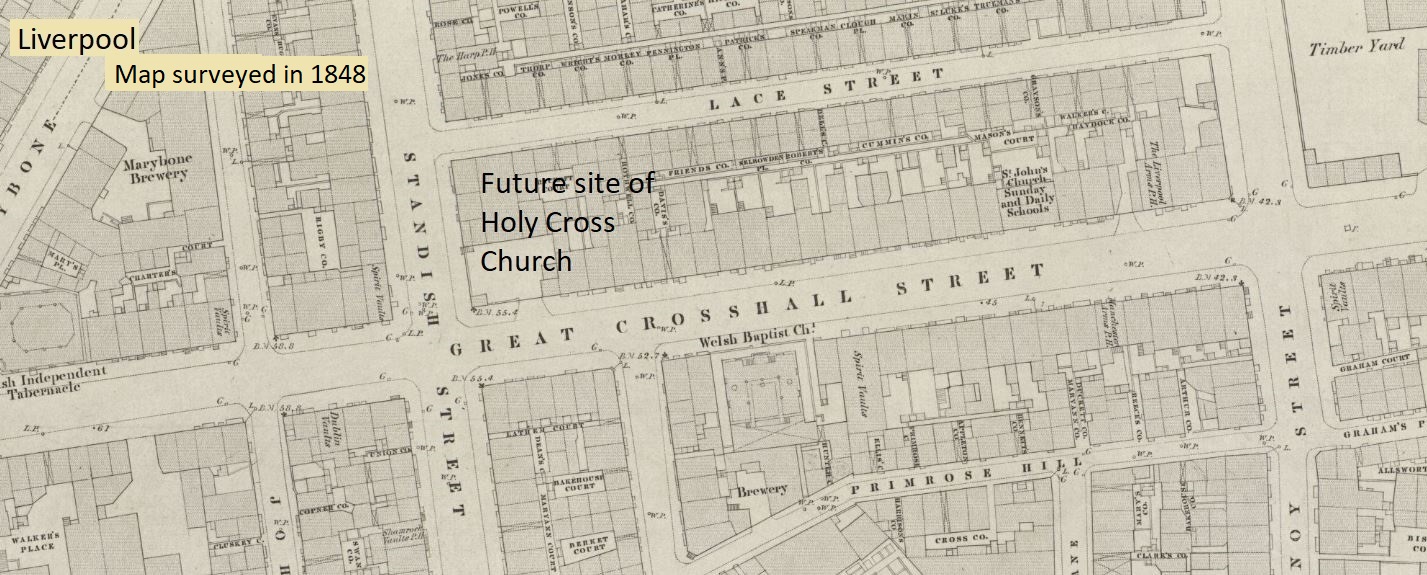
The map was surveyed in 1848 and published two years later. The church where Teresa O'Gorman and Francis Farrar married was not opened until October 1860. Notice the number of courts, as mentioned in the quote above the map.
Although the marriage certificate states Teresa O'Gorman was a spinster, a birth certificate for one of her children gives “Wilson” as the name of a deceased husband, so the Holy Cross marriage may have been her second. If that was the case, why did she lie about her marital status?
I’ve been able to find only three children born to Teresa O'Gorman and Francis Farrar, as in the family tree below. Was this what they wanted – with a big gap between the births of the last two children, or were there many miscarriages? About fifteen months after their marriage, Teresa O'Gorman and Francis Farrar were living in Wigan, where John Joseph Farrar was born. Their next child was Anne Farrar who was born in Stafford in 1864 where the family resided until at least 1872. That was the year when Frances Eliza Farrar was born but, sadly, also the year when her mum Teresa O'Gorman died.
In terms of the Hodkinsons and their Irish ancestry, Francis Eliza's birth was the important one. Half Irish and half English, she would become the wife of John William Hodkinson. Thus, their four children became the first Hodkinsons in my family to have Irish ancestry.
O'Gorman - Farrar - Hodkinson: the roots of Irish ancestry
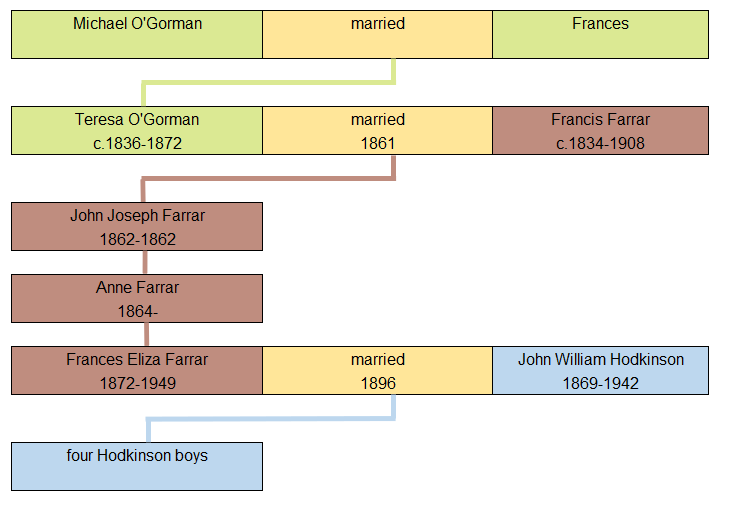
The above is part of the Hodkinsons' family tree, and, for the sake of clarity, has been simplified. The roots of the Hodkinsons' Irish ancestry start with the 1861 Liverpool marriage of Teresa O'Gorman, born in Dublin, and Francis Farrar, born in Billinge (now part of the Metropolitan Borough of St Helens). When Teresa O'Gorman died in 1872, widower Francis married for a second time in 1874. His new wife was Dinah Woolley. More comprehensive Farrar family trees can be found on various genealogical sites, but some lack accuracy.
The marriage of John William Hodkinson and Frances Eliza Farrar on Saturday, 4th April 1896, at St Paul's, Stalybridge
John William Hodkinson and Frances Eliza Farrar get married – who was who on the marriage certificate
St Paul's Church, Stalybridge, the location of the wedding of John William Hodkinson and Frances Eliza Farrar on Saturday, 4th April 1896. (Photograph: Samuel Hodkinson.)
The names on the marriage certificate of John William Hodkinson and Frances Eliza Farrar are those of the groom and bride themselves (of course!); their fathers who were James Hodkinson and Francis Farrar; the two witnesses who were Thomas Edwards and Martha Boardman; and the vicar, T. Holmes Sheriff.
The bride and the groom
John William was 26 years and six months old at the time of his marriage, with the address stated on the certificate as Bower Row, Stalybridge. The family was living at number 11. The marriage certificate gives both of John William’s first names, but only the first and last names of Frances Eliza Farrar. Born in Kidsgrove, Staffordshire, she was just over 24 years of age when she married. Her address on the marriage certificate is given as Zetland Street, which is in Dukinfield and is about two miles away as the crow flies from the location of John William’s home.
It seems certain that the two did not meet through work. Frances Eliza’s occupation was left blank on the marriage certificate, but she had worked in cotton mills. John William was a core maker. That meant there wasn’t a workplace romance. The interesting and unanswered question, then, is where and how did the two meet?
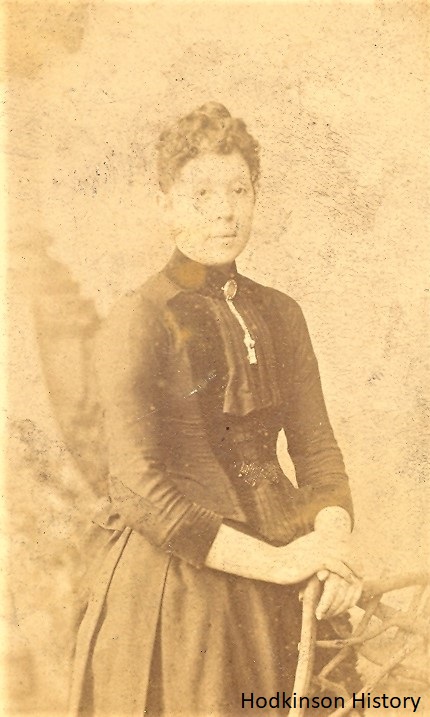
This is an undated photograph of Frances Eliza Farrar, taken at Robinson’s Photographic Studio at 216 Stamford Street, Ashton-under-Lyne. It may have been taken around the time of her marriage to John William Hodkinson in 1896. (Photograph: property of Samuel Hodkinson.)
The parents of the bride and the groom
James Hodkinson, John William's father, died in 1881. John William was only 11 years old and so his memories of his dad would have been faint. John William would be the father to four boys, but none of them was named James; his first son, though, was named George Albert, the first two names of John William’s stepfather, George Albert Kenyon. It was clear who had had the greatest impact on John William’s life, but doubtless he wished that his natural father could have been present at the wedding ceremony.
Frances Eliza’s father was Francis Farrar, with his occupation given as a furniture dealer. Previous stated occupations on official documents were labourer and collier or coal miner. He was born in about 1834 and died in 1908 and certainly would have been present to watch his daughter get married.
The witnesses
Thomas Edwards, born in May 1872 and living in Audenshaw, was one of the witnesses. It looks as though John William Hodkinson got to know the Edwards family because he and another member of the family, David Edwards, were both core makers. The friendship with the family translated in particular to a friendship between John William and the youngest of the Edwards’ four sons, Thomas, who in the 1891 census gave his employment as "cotton operative". Thomas married in 1903; by then he was a "railway official".
Martha Boardman, the second witness, was 21 years old. For at least 15 years, she had been living at 5 Zetland Street, the same street that the bride was living on at the time of the marriage. Living near each other, Frances Eliza Farrar and Martha Boardman got to know each other, with a firm friendship developing. Martha Boardman was still living on Zetland Street when she married in 1899.
The vicar
Finally – and certainly not least! – the seventh name on the marriage certificate is that of Thomas Holmes Sheriff. A Londoner, a graduate of Emmanuel College, Oxford and the fourth vicar of St Paul’s Anglican Church, having taken up the post in 1887, he was 46 years old when he officiated at the marriage of John William Hodkinson and Frances Eliza Farrar. Is his expression one of disdainful tolerance of having his photograph taken?
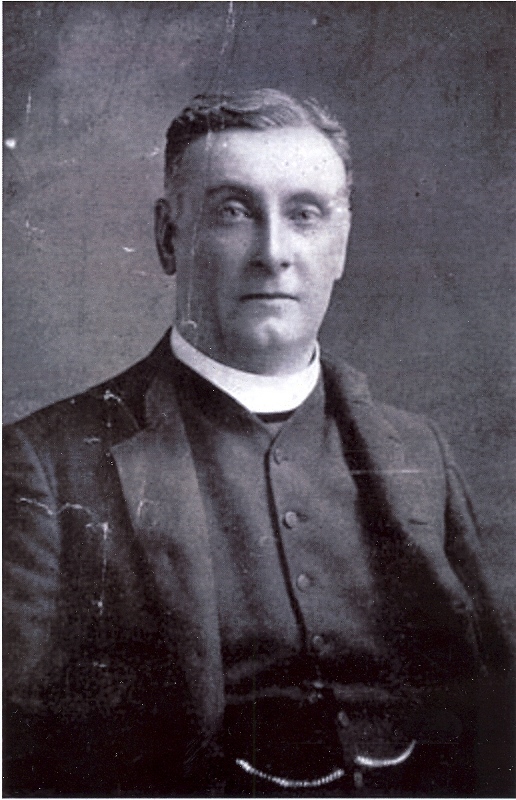
Rev. Thomas Holmes Sheriff, St Paul's Church, Stalybridge. (Photograph: acknowledgements to Tameside Local Studies and Archives.3)
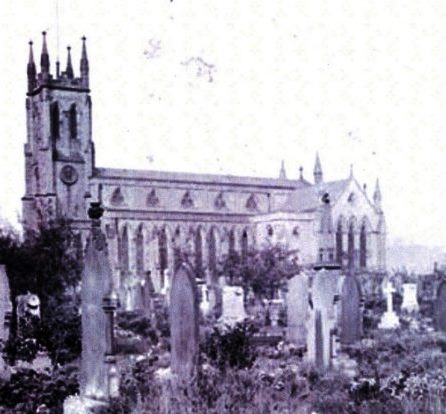
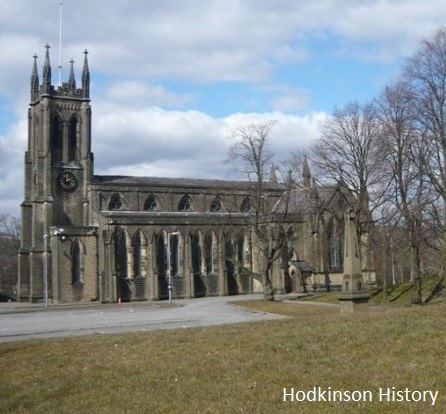
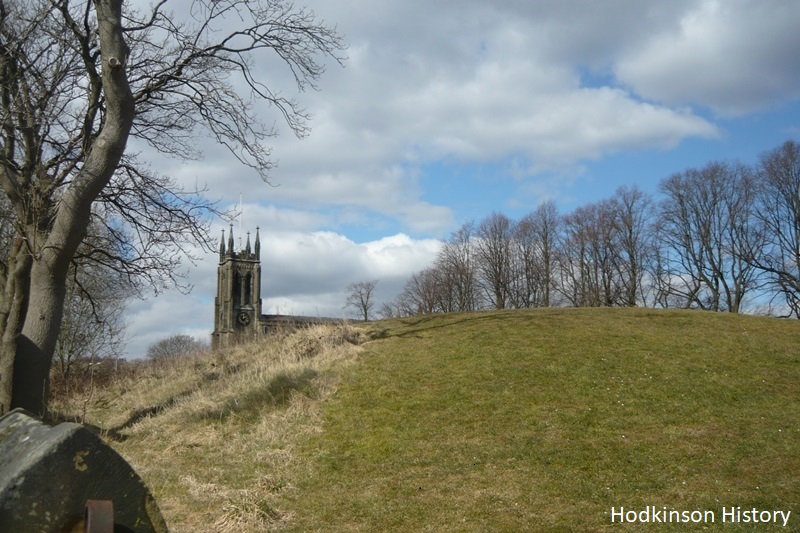
The black and white photograph of St Paul's Church, Stalybridge, is from 1905. (Photograph: acknowledgements to Tameside Local Studies and Archives.4) The second image is over 115 years later. (Photograph: Samuel Hodkinson.)
Looking ahead
Once the ceremony was over, the newly married couple could start to realise their dreams of having a family and having enough income to enjoy a reasonable life style. They could not have foreseen some of the grim days which lay ahead.
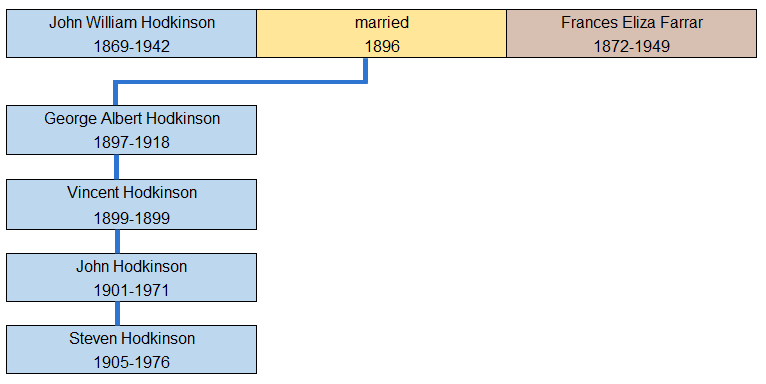
The above is part of the Hodkinsons' family tree and shows the four children of John William Hodkinson and Frances Farrar. The children were the first of my Hodkinson ancestors to have Irish ancestry, inherited from their mother who was half Irish.
John William Hodkinson's journey to Australia, 1911
The future that never happened
John William Hodkinson's 1911 journey to Australia was on the SS Konigin Luise which began its journey in Bremen, and then called at Antwerp (where John William boarded), Southampton, Algiers, Genoa, Port Said, Aden, Colombo, Fremantle, Adelaide, and for John William, the next stop at Melbourne marked the end of a very long journey. The SS Konigin Luise, however, had not quite reached its final destination as it had to carry on to Sydney. Click on the icons to see the ports of call.
In October 1911, 42-year-old John William Hodkinson said goodbye to Frances Eliza, his 39-year-old wife, and to his three children: George Albert, who was thirteen, John who was ten, and Steven who was six, and started his journey to Melbourne. Why exactly he travelled on his own to what was the temporary capital of Australia has been lost during the course of many decades, but of all the possible reasons, there is one which is the best fit, of which more later.
The first leg of the journey to Melbourne: Stockport to Antwerp
In late October 1911, John William headed from Stockport to Antwerp, his boarding port for his ship, the Konigin Luise, which would take him to Melbourne. He had some time to look around the city – certainly a day or two at least – and, on a postcard of the Konigin Luise which he sent back to his wife, commented that it was a fine place for buildings.

The German shipping company Norddeutscher Lloyd, the owner of the SS Konigin Luise, on which John William was a passenger, made the above announcement in the Tasmanian newspaper "Mercury" on 14th November 1906 regarding a 43-day journey time from Southampton to Sydney.
On Saturday 28th October, 270 passengers boarded the ship in Antwerp and all, apart from one, were steerage. 240 were listed as being "English"; 21 were listed as "Welsh", "Irish" and "Scotch"; with the rest being other nationalities. The next morning, at 5 o'clock, the ship set sail on the 15,000-mile journey which would last over 40 days.
The second leg of the journey to Melbourne: Antwerp to Melbourne
The SS Konigin Luise, owned by the German shipping company Norddeutscher Lloyd, started its journey in Bremen before calling at Antwerp – where John William boarded – and then called at Southampton. John William would have watched as almost one hundred first- and second-class passengers boarded at Southampton and would have thought how simpler it would have been if he had travelled from Stockport to Southampton by train and boarded the ship there. Yet the shipping company would not allow that – John William had the cheapest possible ticket which gave him through travel from Stockport to Melbourne, including steerage accommodation on board the SS Konigin Luise, but from Antwerp and not Southampton.
There were a number of reasons for this. One of most important was that Antwerp had been developed as a hub for steerage passengers from all over Europe travelling to all kinds of world-wide destinations on different shipping lines, including Norddeutscher Lloyd. Antwerp had the organisational capabilities and the facilities, which included customs, medical services and sleeping accommodation, to deal with large numbers of passengers and all their luggage. In that respect, Southampton could not match Antwerp and was able to deal only with smaller numbers, especially as the duration of stops at Southampton were timetabled for much shorter periods than at Antwerp. The demand for boarding at Southampton was easily choked off by selling only higher priced/higher status tickets.
Getting a cheap fare, but going by a longer route, is still with us nowadays. Some train companies offer cheap tickets for some journeys, but the routes are not necessarily the quickest and most direct. Budget airlines offer cheap tickets, but often serve airports which are not as easy to get to as the larger airports, thus adding extra distance and time to journeys.
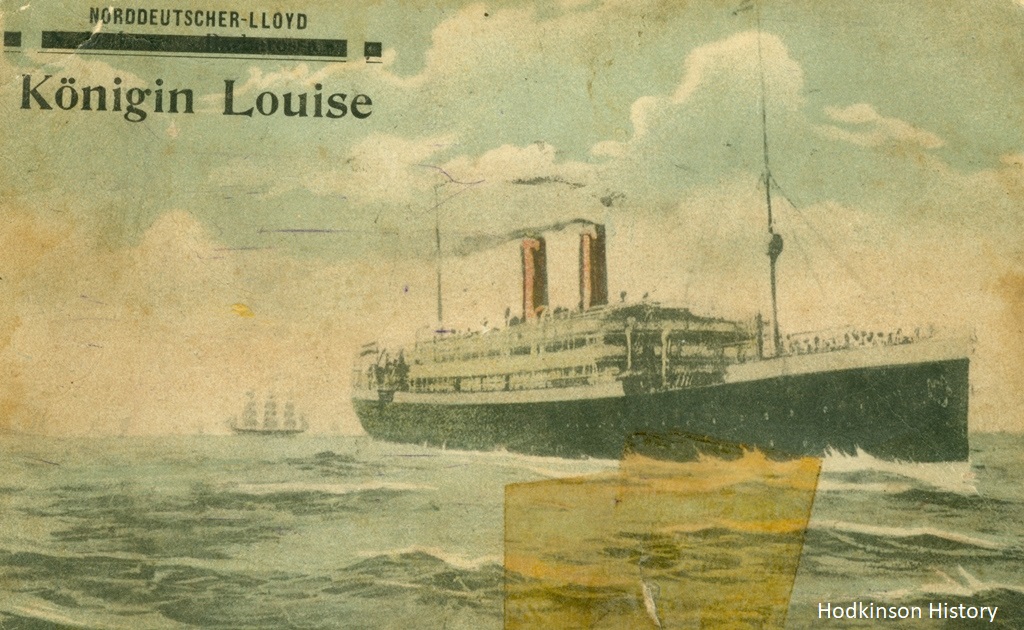
In October, John William sent the above postcard to his wife saying that he was impressed with the smoothness of the journey, and that "You can't tell that you're sailing." He also said that it was very cold as they passed through the Straits of Dover and that his overcoat came in handy. The sellotape repair to the rip in the postcard was carried out many decades later by John William's youngest son and so has become part of its history. (Postcard: property of Samuel Hodkinson.)
Only one person joined at Antwerp who was not a steerage passenger. She was a first-class ticket holder, Miss G Robin, who was 35, English, with her occupation given as "Barrister". Separate arrangements would have been made for her to join the boat – after all, there is no way that she could have joined a steerage-class queue.
On the way to Melbourne, John William witnessed more passengers joining the ship until there were 671 on board, of whom 401 were in steerage including 24 children.
Those that John William came into contact within steerage accommodation came from a wide variety of work backgrounds. The occupations listed included: butcher, carpenter, engineer, musician, labourer, trader, soldier, miner, farmer, farrier, printer, waiter and gardener. The nationalities were also diverse. Apart from those from the British Isles, other nationalities included: Danish, Russian, German, Sinhalese, Spanish, Italian and Swiss.
John William would have formed friendships with many of those in steerage and would never have been short of somebody to chat with, including, maybe, the oldest person making the trip, a Mrs F Hill, who was 82.
In the first week of December 1911, with goodbyes said to other passengers, John William Hodkinson disembarked from the SS Konigin Luise and set foot on Australian soil, the third Hodkinson to do so. His step-grandfather, William Hodkinson (1798-1858), was stationed in New South Wales from about 1827 to 1833 as a private in the 39th Regiment of Foot. His aunt, Lucy Hodkinson (1836-1893), landed in Queensland in 1870 when her family emigrated there. A more recent member of the Hodkinson family spent time in Australia, but eventually returned to the UK.
So ... why did John William travel to Australia?
What is key to understanding why John William went to Melbourne were his responsibilities as head of the household. His family needed to be provided for during the time he spent travelling to and from Melbourne (about three months in total) and for the duration of his stay in Melbourne itself. He had given up his job as a core maker in a factory in Reddish, so he no longer was earning a wage. His family needed to live – perhaps they had savings to sustain them but that is highly improbable. Within that context, it is hard to believe that John William went to Melbourne without thinking about the welfare of his family.
That being so, there are a couple of reasons for John William's journey that can be discounted straight away. One is that he went to Australia simply because he wanted to, and didn't consider, or care about, the ramifications for his wife and young family.
A second reason could be that John William went to visit relatives. After all, his aunt, Lucy Hodkinson (who married William Henry Newton in 1866), had moved to Australia about four decades earlier. However, Lucy's descendants (she died in 1893) lived in a town in Queensland, about a thousand miles away from where John William landed. It is too be wondered what he actual knew about his relatives in Queensland.
When in Melbourne, John William wrote to his wife letting her know where to send mail to him – in his name, care of the post office in Melbourne, and marked, "to be called for", which was hardly the indication of someone on a short-term visit.
There can't be any doubt that John William went to Melbourne to look for better-paid work. As a core maker, he would have earned wages that were much higher than those in Stockport. Possibly, he may have regarded his employment in Melbourne as a long-term, but temporary money-earning venture, with the intention of always returning to Stockport.
Most likely of all – and like many other heads of households – John William went to Australia not only to find well-paid work (with remittances being sent to his wife), but also to assess whether the rest of his family should join him on a permanent basis for a better life for all. If that had happened, the history of the family would have moved to a different trajectory with John William's grandchildren born as Australians.
How long John William remained in Melbourne is not known, but eventually, when more oceanliner passenger lists have been digitalised and made public then, hopefully, his return journey details will be available. Why John William returned when he did is also not clear. Maybe he felt that the future of his family did not lie in Australia. Maybe, if he was still there in 1914, he decided to return home to be with his family as tensions mounted between countries in Europe that eventually led to war.
John William was definitely back in Stockport by October 1914. On 5th October, he became Private John William Hodkinson when he joined the 3rd (Special Reserve) Battalion of the Cheshire Regiment. On the same day, he was mobilised to Birkenhead. He had been there four days when Antwerp – the city where he started his long sea journey to Melbourne on the SS Konigin Luise – surrendered to the Germans after a two-week siege.
John William Hodkinson: 1869-1896 – birth to marriage ... this page
John William Hodkinson: 1896-1942 – marriage to death
John William Hodkinson: 1900-1917 – three times a soldier
John William Hodkinson: 1869-1942 – eighteen homes
Notes and sources for this page
- Unless otherwise mentioned, this page is based on copies of birth, marriage and death certificates; census returns; and family documents and related items including photographs which are the property of Samuel Hodkinson.
- Richard Haslam and Michael Hughes, OMI. (https://www.omiworld.org/lemma/liverpool-holy-cross-parish-1850-2001. Accessed: 15th August 2023.)
- www.tameside.gov.uk., Tameside Image Archive. (http://www.tameside.gov.uk/history/archive.php3. Accessed: 15 June 2010.) Image t15775.
- www.tameside.gov.uk., Tameside Image Archive. (http://www.tameside.gov.uk/history/archive.php3. Accessed: 15 June 2010.) Image t15758.
This page was originally published in August 2010 with the latest updates made on 4th August 2024.