
1838–1899 Hodkinsons who died young
This page is dedicated to those members of the Hodkinson family who died when they were young. Unfortunately, it does make for sad reading.
1802–1805 Thomas Hodkinson
Tuesday 19th October 1802 – about 2nd August 1805
(2 years and 9 months)
Thomas' family and home
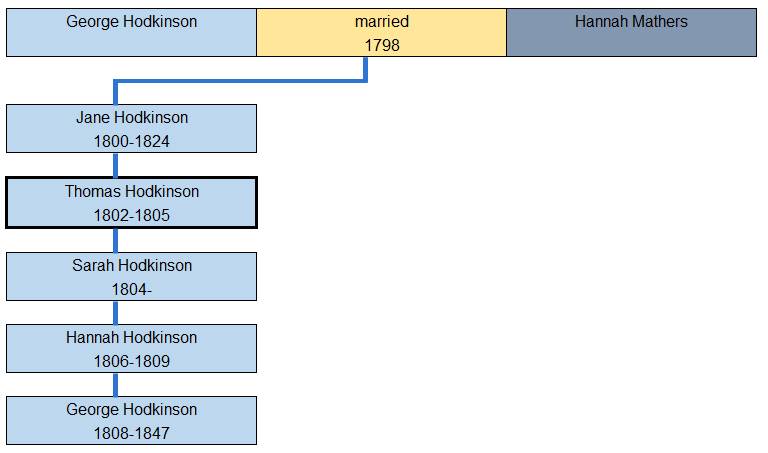
As can be seen below, Thomas was the second child and first son born to George and Hannah Hodkinson (nee Mathers). The birth took place in the parish of Stockport. There is no date for his death, but his burial is recorded as taking place on Monday, 5th August 1805. The cause of his death is unknown.
After a lot of research I think I have included all the children of George and Hannah in the family tree below but there is alway a chance that there might well be others.
1806–1809 Hannah Hodkinson
Tuesday 19th October 1802 – about 2nd August 1805
(2 years and 9 months)
Hannah's family and home
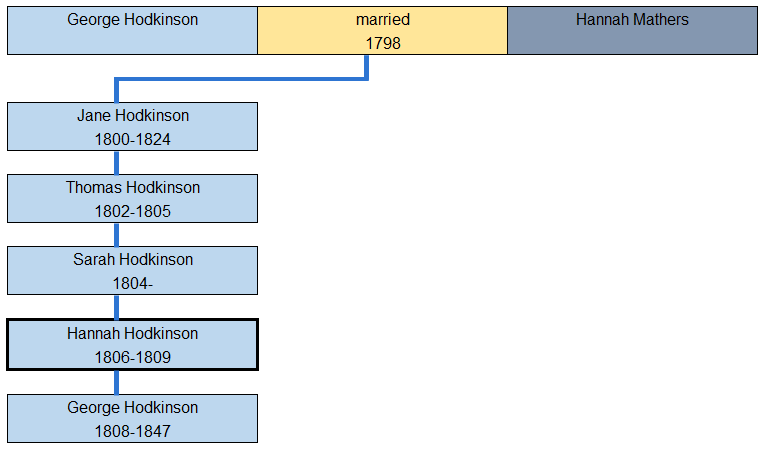
As can be seen below, Hannah was the fourth child and third daughter born to George and Hannah Hodkinson (nee Mathers). It is a possiblility that she was born, and died, in the Hillgate part of Stockport. The cause of her death is unknown.
1838–1839 William Hodkinson
Friday, 14th September 1838 – Saturday, 20th April 1839
(7 months and 1 week)
William's family and home
As can be seen below, William was the third child and first son born to George and Hannah Hodkinson (nee Oldham). The birth took place at their home on (Higher?) Bury Street in Heaton Norris, Stockport.


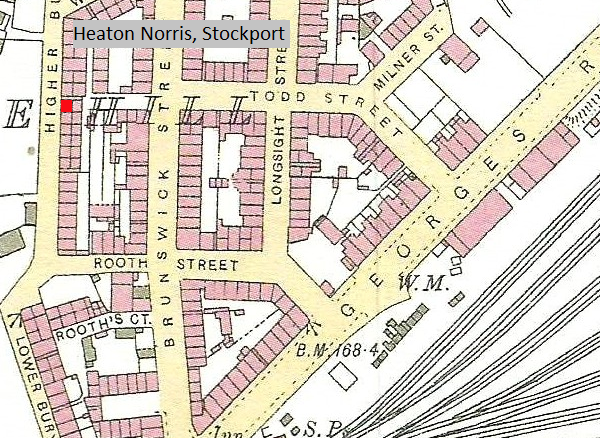
The photograph is of Higher Bury Street in 1961 where William Hodkinson spent his short life over 120 years earlier. (Photograph: reproduced courtesy of Stockport Metropolitan Borough Council Image Archive. 1)
The birth and death certificates for William state he lived on "Berry Street", which was a misspelling of "Bury Street". No house numbers are stated for Hodkinson addresses in official documents from 1838 to 1841, but it appears that the family lived on Higher Bury Street during this time, in or near the house indicated on the map. The home was a back-to-back house with very limited space.
William's death and burial
The death certificate for William Hodkinson states the cause of his death to be "smallpox". Sadly, the Hodkinson family had been caught up in the smallpox epidemic of 1837-1840 and William, the youngest member of the family, was a victim.
Smallpox, one of the most devastating diseases ever known, has more or less passed into history, but in Victorian times, despite compulsory vaccination for infants from 1853, it was a disease that people truly feared - "the most terrible of all the ministers of death," as the Victorian historian Macaulay wrote.2
Smallpox was contagious and was transmitted from person to person by way of infected droplets during close contact (usually face-to-face) with infected people. It seems quite likely that William Hodkinson was cuddled by someone who had the disease and who was probably in the early part of the contagious stage but did not realise it.
Smallpox was characterised by high fever, fatigue, headaches and backaches followed by rashes which developed into round and hard pus-filled lesions embedded in the skin. The historian Lord Macaulay wrote of the disease turning "the babe into a changeling at which the mother shuddered".3 "Babes" were more likely to die than adults and where smallpox was fatal, the virus crippled the immune system, with death generally occurring in the second week of illness. The suffering endured by seven-month-old William doubtless was alleviated by the use of opiates, such as the respected Godfrey's Cordial which was based on pure opium, or maybe by doses of laudanum, which was a mixture of alcohol and morphine.
The distress of the rest of William’s family as they watched the youngest member of the family suffer would have been huge, with any faint hopes of a recovery being dashed when he died on Saturday, 20th April 1839. Amidst the grief, George and Hannah registered the death on Tuesday, 23rd April 1839, the same day that the funeral took place at Stockport Municipal Cemetery. For a family in mourning and with limited financial resources, the burial fee of 6s 6d (32½p) simply added to a truly miserable time. It is to be hoped that they subscribed to a so-called Burial Club and so had some or all of those expenses covered.
1846 Elizabeth Hodkinson
Tuesday, 7th April 1846 to Friday, 10th April 1846
(3 days)
Elizabeth's family and home
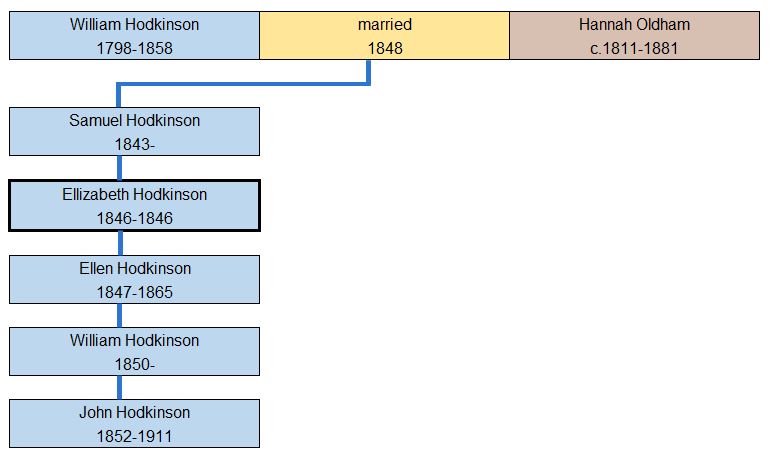
Hannah and William Hodkinson had five children. Prior to those births, Hannah also had four children with her estranged husband, George Hodkinson. (See family tree above.) Elizabeth was the sixth child and the third girl of the nine children who were born to Hannah Hodkinson and the second child and first girl for William Hodkinson.
Elizabeth Hodkinson was born at 44 Mottram Street, Stockport on Tuesday, 7th April 1846 and her birth was registered the following day. This was the quickest registration of all Hodkinson births – perhaps the parents felt they needed to act quickly as they had concerns about Elizabeth's health more or less as soon as she was born.
Elizabeth died on the Friday of the same week with her father, William Hodkinson, present. The death certificate states the cause of death as "convulsions", but this was the diagnosis of her father, if not also of her mother. John Shawcross, the Registrar wrote on the certificate that the cause of death was "Not certified. No Medical Attendant".
Elizabeth was buried on Sunday, 12th April 1846 at the family's parish church, St Thomas', Hillgate, Stockport.
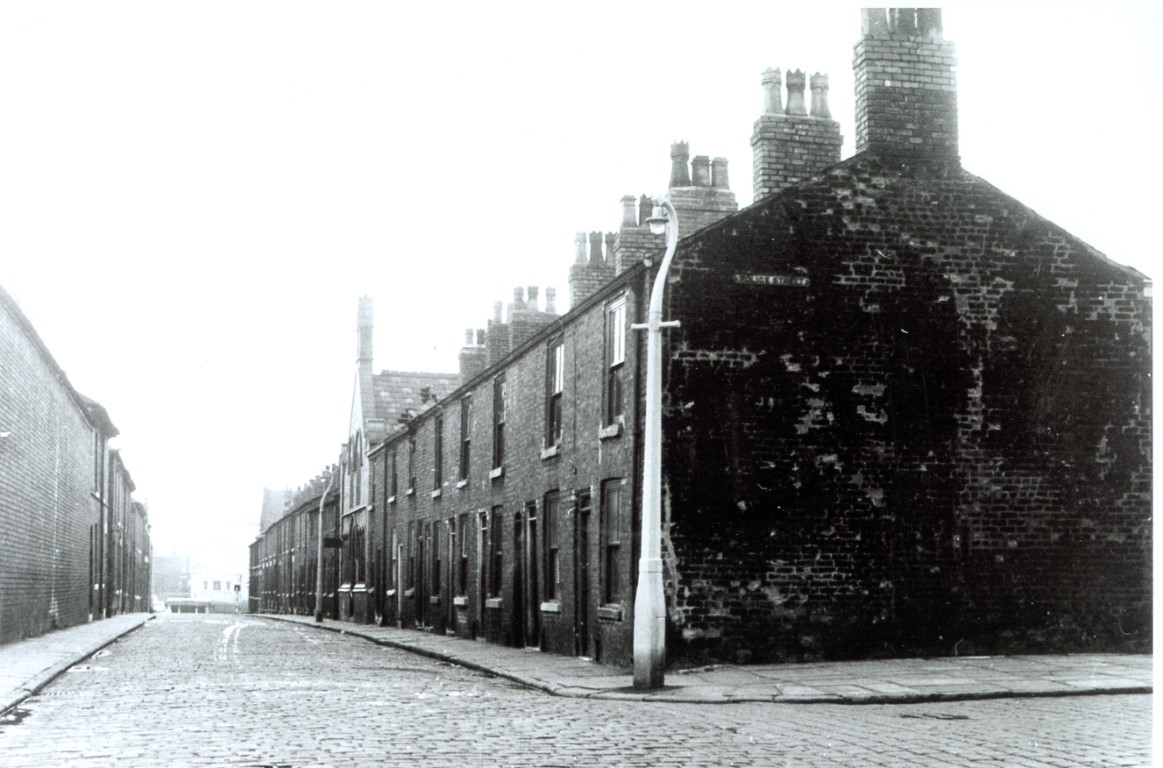
The photograph is a 1960s view of part of Mottram Street from its junction with Police Street. Elizabeth Hodkinson died at 44 Mottram Street which was two doors to the right of the Mission Church of St. John's which was prominent in the row of terraced houses on the right-hand side of the street. (Photograph: reproduced courtesy of Stockport Metropolitan Borough Council Image Archive.1)
1847-1865 Ellen Hodkinson
Monday, 5th April 1847 to Saturday, 11th February 1865
(17 years and 10 months)
Hannah and William Hodkinson had five children. Prior to those births, Hannah also had four children with her estranged husband, George Hodkinson.
Ellen was the seventh child and the fourth girl of the nine children who were born to Hannah Hodkinson and the third child and second girl for William Hodkinson.
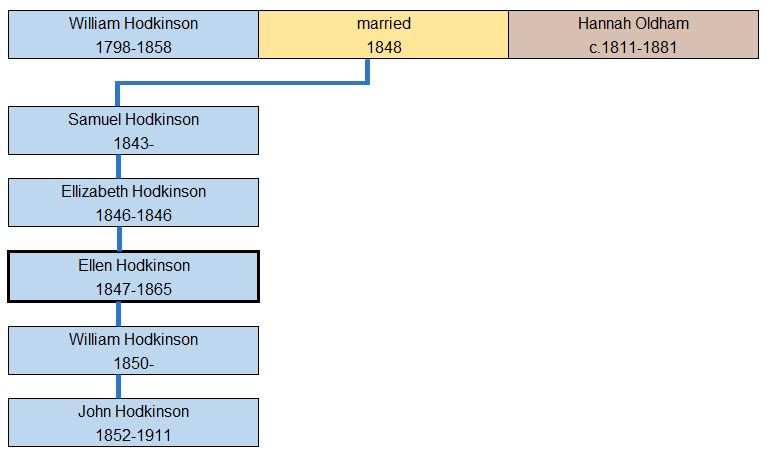
Ellen Hodkinson's homes
Ellen Hodkinson was born at 44 Mottram Street, Hillgate, Stockport. She joined a crowded household – the Hodkinson family already had six members. A family move took place at some point before 1850 to nearby 44 Ratcliffe Street.
Ellen Hodkinson at work
"Tenter in a Cardroom" is the description in the 1861 census for Ellen Hodkinson’s occupation. In the 21st century, unlike in the Victorian era, "Tenter in a Cardroom" is certainly a phrase which would confuse most people and, if they were asked what it meant, probably would give some strange answers!
Cards – the machines to separate fibres in cotton – were to be found in a cardroom, but this room would have had other machines which dealt with other aspects of the spinning process. Those who looked after (tended) machines were known as ‘tenters’.
Legally Ellen was able to work when she reached the age of 9 in 1856, but it is quite likely she started work at a younger age, almost certainly in a cotton mill. Her hours of work were regulated by law – but working days were long. Up to the age of 18, the hours worked were to be, at most, from 6 a.m. to 6 p.m. in the summer and (with factory inspector approval) 7 a.m. to 7 p.m. in the winter. During these 12 hour periods, breaks totalling 1½ hours were stipulated, meaning hours worked were a maximum of 10½.
The 1861 census entry is all that we know about Ellen's occupation, but it is a fair assumption that she spent her working life in cotton factories.

This often-used 1840 illustration1 shows machines in the carding, drawing and roving room of a mill in Preston. The room appears spacious, helped by a high ceiling necessary for the height of the machines; the workers looked well-dressed; the work floor is not crowded; and the illustration gives the impression of a relaxed working environment.
Ellen Hodkinson worked in a similar cardroom and experienced work conditions that the illustration cannot convey: the high level of noise, the humidity, the dusty atmosphere, the boring long hours, the low wages with no job security, the hunger, the lack of sleep creating an overwhelming feeling of tiredness, the necessity of having to work when ill or heavily pregnant — and the list could be longer.
Ellen Hodkinson's death and burial
Nowadays, such deaths are virtually unheard of in the UK, but there are still cases of typhoid fever, more often than not because the infection has developed in those who have been on visits abroad. The NHS website comments that the disease is most common in parts of the world that have poor sanitation and limited access to clean water,2 a comment that applies equally to the Victorian era in the UK.
The symptoms of typhoid fever include a high temperature, headache, general aches and pains, a cough and constipation. Worse are the complication which can set in: one is internal bleeding; the other is the splitting (perforation) of a section of the digestive system or bowel, which spreads the infection to nearby tissue and can cause multiple organ failure, leading to death.3
If doctors were unable to prevent Prince Albert’s death from typhoid fever in 1861, then what hope was there for Ellen, a working-class 17-year-old, seriously ill in a noisy slum dwelling, with no access to medical help? In the 21st century, antibiotics can successfully treat typhoid fever within two weeks after early-stage diagnosis. For Ellen, two weeks of typhoid fever (as stated on her death certificate) was the time it took for the infection to end her life.
The graveyard of St Thomas’, Hillgate – the Hodkinsons' family church – closed in 1856 when it became full. Ellen’s final resting place, therefore, was to be in Stockport Municipal Cemetery. The burial took place on a cold day and, taking into account the weather patterns for February 1865, it is quite likely that there was snow was on the ground.
1872-1874 Ellen Hodkinson
Sunday, 20th October 1872 to Friday, 27th March 1874
(17 months and 8 days)
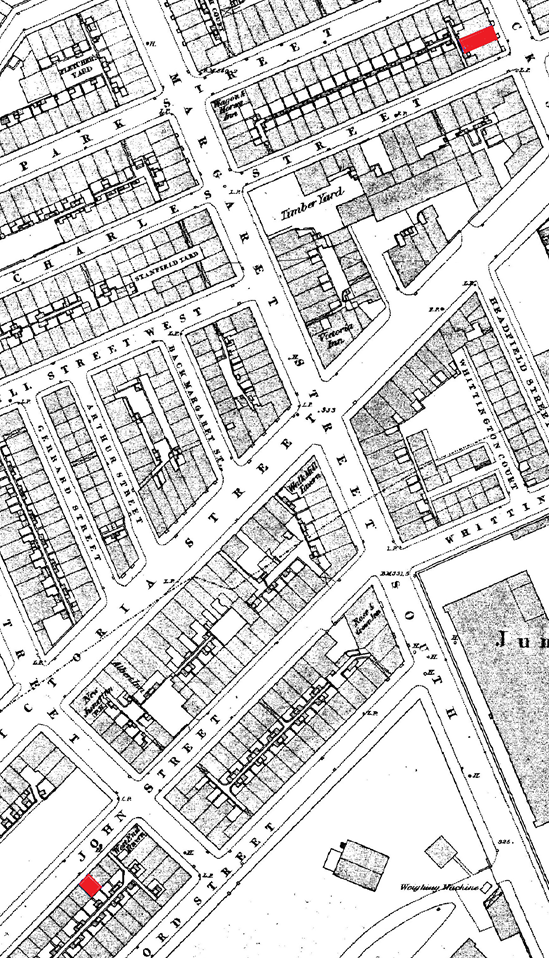
The two homes of Ellen Hodkinson, on Welbeck Street (top) and John Street (bottom), Ashton-under-Lyne, are marked in red.
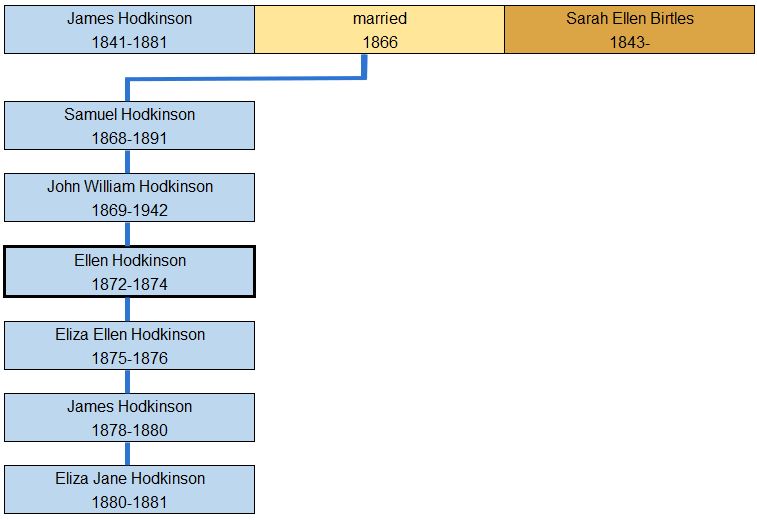
Sarah Ellen and James Hodkinson had six children, with Ellen Hodkinson being the third child and the first girl. Four of their children died at very young ages; another died at the age of 23. One historian has commented "... as the letters, diaries and memoirs of men and women from all levels of society show, having more children never compensated emotionally for those who were lost." 1
Ellen's homes
Ellen Hodkinson was born at 45 Welbeck Street on Sunday, 20th October 1872 and her birth was registered on Tuesday, 5th November by her mother, Sarah Ellen Hodkinson, who being unable to write, signed the birth register with a cross. One year later, the Hodkinsons were living on John Street where Ellen died on Friday, 27th March 1874.
Ellen's death
Ellen Hodkinson’s death certificate states the cause of death to be cynanche trachealis, more commonly known as ‘croup’. Nowadays, death from croup is rare, but not so in Victorian times. Then, as now, the disease tended to affect children between one and two years old — Ellen Hodkinson was one year and five months.
In 1813 John Cheyne, a fellow of the Royal College of Surgeons, Edinburgh, wrote of his experiences of dealing with the disease and this graphic description of a child with cynanche trachealis gives an indication of how, sadly, Ellen may have lived through her last hours.
The disease generally comes on in the evening, after the little patient has been much exposed to the weather during the day, and often after a slight catarrh of some days standing. At first her voice is observed to be hoarse and puling; she shuns her play-fellows, and sits apart from them, dull, and, as it were, foreseeing her danger. Her illness, indeed, does not prevent her from going to sleep, but soon she awakes with a most unusual cough, rough and stridulous. And now her breathing is laborious, each inspiration being accompanied by a harsh shrill noise, most distressing to the attendants.
Her face is swelled and flushed, and her eye bloodshot; and she seems in constant danger of suffocation: Her skin burns, and she has much thirst ; she labours more and more in breathing ; still the ringing noise is heard, and the unusual cough: She tries to relieve herself by sitting erect ; no change of posture, no effort gives her relief. Generally her sufferings are thus protracted until morning, when perhaps there is a slight remission; her breathing is a little easier, but the anxiety, the fever, and the cough remain; she is soon as ill again as ever; and these symptoms continuing, weakened by the violence of her illness, with purpled lips and leaden countenance, she dies in two or three days. In other cases, the disease, after continuing some time, appears suddenly alleviated: The breathing is free, the child soon becomes cheerful, her appetite for food returns, she amuses herself, and seems perfectly recovered, and the hope of every one is raised, only to make the disappointment more keen; for the child suddenly gets worse, and dies, her livid and swollen face and convulsive struggles giving her the appearance of one that is strangled.2
The registrar, William Walker, recorded Ellen's death with the surname of "Atkinson" — an echo of her parents' wedding registration when James Hodkinson was recorded as James Atkinson. Since both parents were illiterate, they were unable to check the spelling of their surname.
Having experienced the death of their first daughter, James and Sarah Ellen would have been horrified if they had known that their next three children would also die at very young ages.
1875-1876 Eliza Ellen Hodkinson
Wednesday, 13th October 1875 to Wednesday, 29th March 1876
(5 months and 16 days)
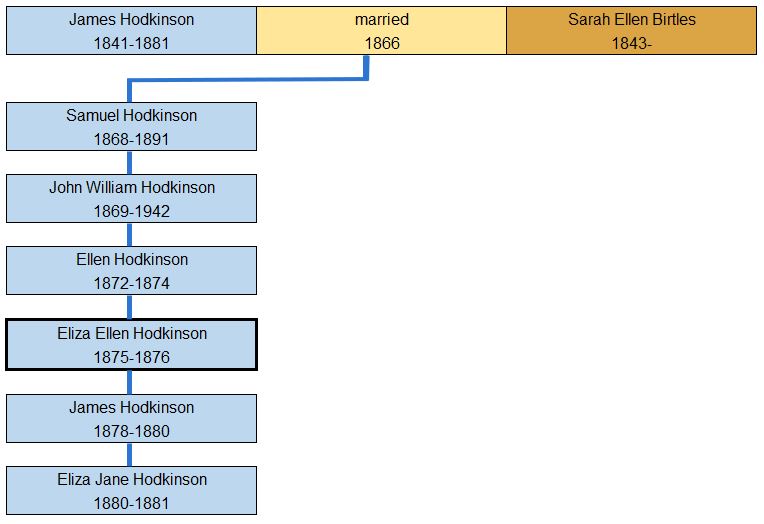
Sarah Ellen and James Hodkinson had six children, with Eliza Ellen Hodkinson being the fourth child and the second girl.
Eliza Ellen's home
Eliza Ellen Hodkinson was born at 31 John Street, Ashton-under-Lyne, on Wednesday, 13th October 1875 and her birth was registered on Thursday, 25th November 1875 by her father, James Hodkinson, who being unable to write, signed the birth register with a cross.
Eliza Ellen died on Wednesday, 29th March 1876 at the same address. Her day and month of birth and of death are similar to those of her sister, Ellen, who was born on 20th October (1872) and died on 27th March (1874).
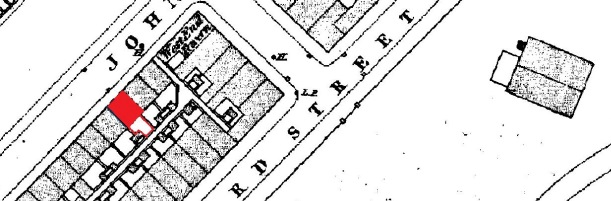
The home of Eliza Ellen Hodkinson on John Street, Ashton-under-Lyne, is marked in red. See the map a short distance further up this page which shows John Street in a wider context.
Eliza Ellen's death
Eliza Ellen Hodkinson’s death certificate states the cause of death to be "wasting". Her death was certified by Dr. A. Hamilton, L.R.C.P. (Licentiate of the Royal College of Physicians).
In 1878, Dr Eustace Smith wrote a book dealing with The Wasting Diseases of Infants and Children and some of the headings from the summary to the introduction are worth quoting:
Wasting a sign of defective nutrition
-Importance of detecting the cause of mal-nutrition
-Wasting not always the first sign, and may even be absent in slight cases
-Defective nutrition may be the result of acute disease
-Liability of badly nourished children to secondary acute diseases
...
General Treatment of Wasting.
-Uselessness of tonics so long as there remains any derangement of the stomach or bowels
-Importance of minuteness in giving directions about diet.
-Cod’s liver oil must not be given in too large doses.1
The first sentence in the book’s introduction aptly sums up the disease: "Wasting is a sign of defective nutrition: the waste of the body continues, but new material is introduced in quantity insufficient to supply the loss of tissue." 2 Sadly the poverty levels for the Hodkinson family were such that Eliza Ellen could not get the nutrition that she needed to stay alive.
1878-1880 James Hodkinson
Saturday, 16th February 1878 to Sunday, 25th January 1880
(1 year, 11 months and 9 days)
Sarah Ellen and James Hodkinson had six children (three boys and three girls), with James Hodkinson being the fifth child and the third boy.
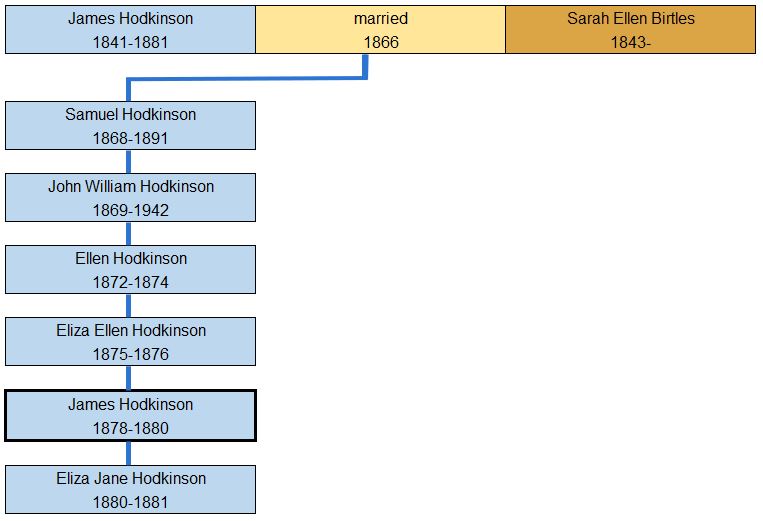
James Hodkinson was born at 31 John Street, Ashton-under-Lyne, on Saturday, 16th February 1878 and the birth was registered just under a month later by his mother, Sarah Ellen Hodkinson.
James' death
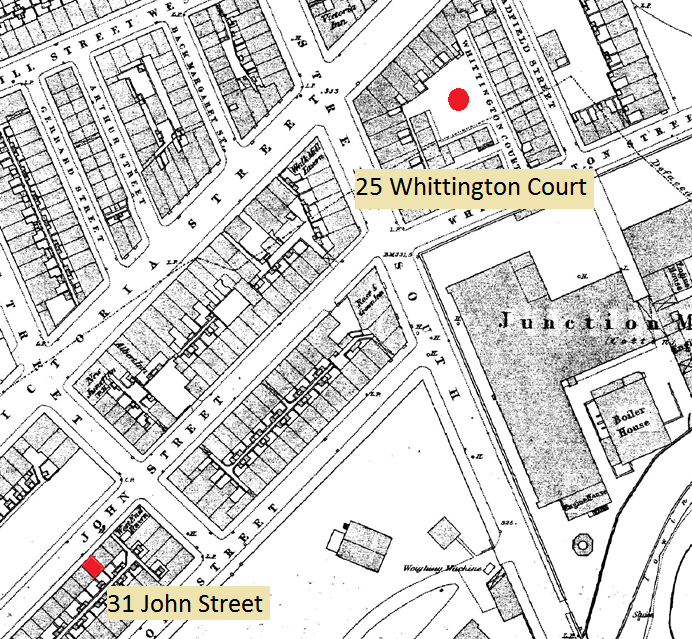
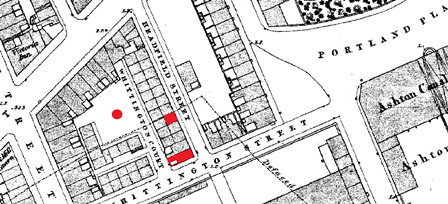
James Hodkinson’s death certificate states the cause of death to be ‘bronchopneumonia', certified by Dr. A. Hamilton. James died on Sunday, 25th January 1880 at 25 Whittington Court, Ashton-under-Lyne. (The location of Whittington Court is where the red dot is on the map. The actual location of house 25 is not known.)
1880-1881 Eliza Jane Hodkinson
Sunday, 12th September 1880 to Saturday, 30th July 1881
(10 months and 18 days)
Sarah Ellen and James Hodkinson had six children, with Eliza Jane being the last.
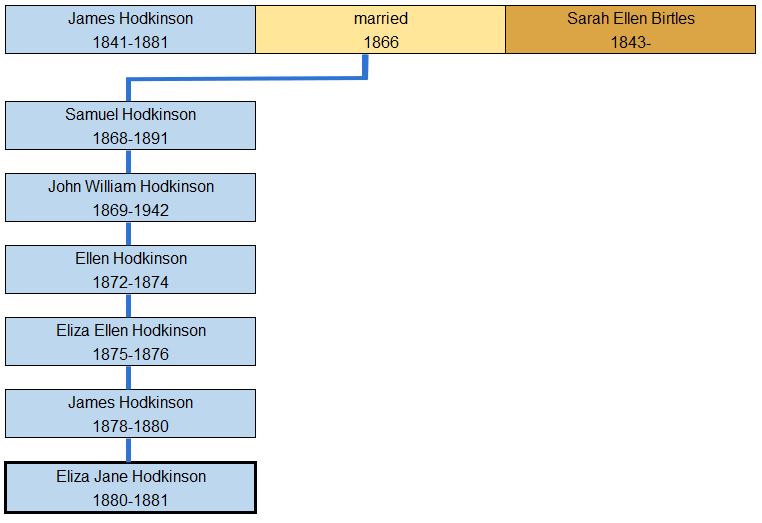
Eliza Jane Hodkinson's mother, Sarah Ellen Hodkinson, was present at her daughter's death on Saturday, 30th July 1881. It was the culmination of a dreadful seven years. As can be seen from the information about her children above, her first daughter, Ellen Hodkinson, died at the age of 17 months in 1874; her second daughter, Eliza Ellen Hodkinson, died at the age of 5 months in 1876; and her third son, James Hodkinson, died at the age of 23 months in 1880. To makes matters far worse, her husband died in February 1881, just under six months prior to Eliza Jane's death.
Eliza's arrival on Sunday, 12th September 1880 had brought the number of Hodkinsons back to five following previous child deaths in the family. She was given the same first name as Eliza Birtles, her mother's sister, and she joined brothers Samuel who was twelve and John William who was almost eleven.
Eliza Jane's homes
Eliza Jane Hodkinson was born at 25 Whittington Court on Sunday, 12th September 1880. By 1881 the Hodkinson family had moved around the corner to Headfield Street. They occupied 1 Headfield Street for a while and then moved again to 9 Headfield Street where Eliza Jane died in July 1881.
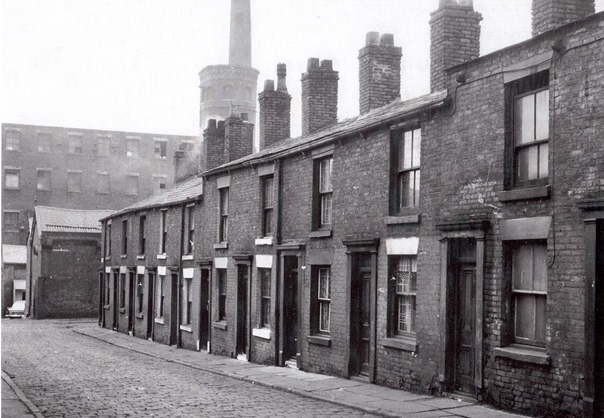
(Photograph: reproduced courtesy of Tameside Local Studies and Archives.1)
The 1960s photograph shows the second-generation housing on Headfield Street, built at some point between 1881 and 1884, after the death of Eliza Jane. That being so, the Hodkinsons never lived in the houses shown in the photograph, but they lived briefly at the equivalent of number 1 at the bottom of the street on the photograph and then at the equivalent of number 9, a few doors further up next to the first step in the roof line. Marked in red on the map are the locations of the three homes of Eliza Jane Hodkinson. The precise location of 25 Whittington Street is unknown.
Eliza Jane's death
The sub-district (SD) of Audenshaw, whose boundaries at that time included 9 Headfield Street, where Eliza Jane died, had a population of 19,862 in 1881. She was one of the 75 infant deaths which were recorded in that year.
The three greatest threats posed to the lives of children were, using the General Register Office (GRO) 1860-1896 classifications, "diseases of the respiratory system", "diseases of the nervous system" and "diarrhoea and dysentery".2 If medical diagnoses of the reasons for death are assumed to be accurate (which is a much debated issue), then during the 1880 decade, 1,134 children in Ashton-under-Lyne Registration District (RD) under the age of five died from diarrhoea and dysentery. Of these, 865 did not reach their first birthday. Eliza Jane Hodkinson fell into this category with the cause of her death recorded as "diarrhoea".
In his book on public health in Victorian England, Wohl wrote "The causes of gastro-intestinal diseases are complex – the baby’s general condition and its resistance to disease, dentition and feeding during the teething period, summer temperatures [Eliza Jane died at the end of July], excrement removal and general sanitary conditions are among the factors involved …"3
Eliza Jane’s death was certified by Dr. A. Hamilton and registered two days later on Friday, 1st August 1881. Dr Hamilton's name appears on the death certificates of four of the five Hodkinsons who had died since 1874 and, as he completed the GRO pre-printed death certificate form, doubtless Dr. Hamilton remembered certifying the deaths of the other members of the same family.
1899 Vincent Hodkinson
Wednesday, 4th January 1899 to Thursday, 16th March 1899 (2 months and 12 days)
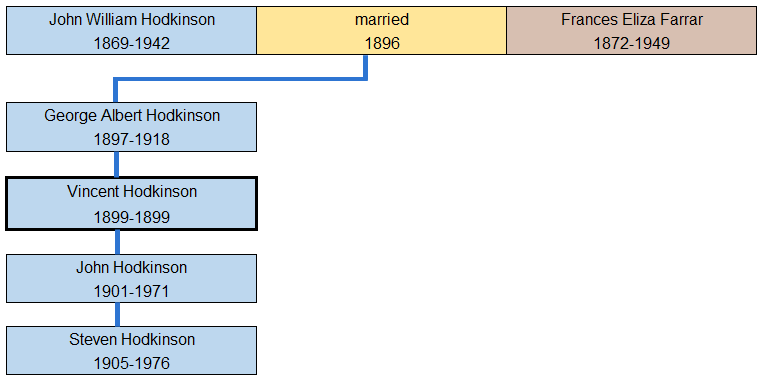
Frances Eliza and John William Hodkinson's children were all boys, with Vincent being the second. John William was 29 years old and Frances Eliza was 27 at the time of his birth.
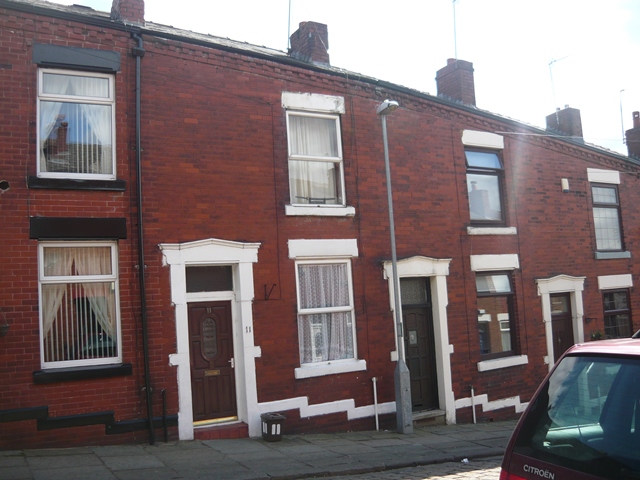
The house with the brown door is 11 St. Paul's Street, Stalybridge, birth-place of George Albert Hodkinson in 1897 and Vincent Hodkinson in 1899. (Photograph: Samuel Hodkinson.)
Vincent was born on Wednesday, 4th January 1899. His first name was unusual in that no other Hodkinsons had been christened with the same name – but his father always like to do something that was different! He was the second child to be born at 11 St. Paul’s Street, Stalybridge. His death, on Thursday, 16th March 1899, is recorded as taking place at 4 Ardern Field Street, Stockport, which was the address of his grandmother who was present at his death. The grandmother was Sarah Ellen Kenyon, who as Sarah Ellen Hodkinson, had lived through the deaths of five of six of her own children, as can be seen higher up this page.
Vincent's death
Vincent’s death was certified by Thomas. F. Bamford, M.B. (Bachelor of Medicine, then the usual degree for a doctor). He was 27 years old and lived a short distance away, near St Thomas’s church, where Vincent’s grandfather, James Hodkinson, had been baptised in 1842.
The cause of Vincent’s death, like that of Samuel Hodkinson (1868-1891) and James Hodkinson (1878-1880), was stated as ‘bronchopneumonia’ whose outward symptoms can include fever, coughing (including coughing up blood-streaked mucus), chest pain, chest congestion, chills, and difficulty with breathing.
George Albert Hodkinson was now the only child, but in the new century two more boys would be born into the family. Sadly, George Albert would be killed in 1918 in France.
Notes and sources for this page
1838-1839 William Hodkinson
- Stockport Metropolitan Borough Council, Stockport Image Archive. (http://www.stockport.gov.uk/services/leisureculture/libraries/libraryonline/stockportimagearchive. 10 May 2013.) Image 2756.
- Thomas Babington Macaulay, The History of England, from the Accession of James the Second. (London: Longmans, Green and Co. 1886.) Volume 2, p.498.
- Thomas Babington Macaulay, The History of England, from the Accession of James the Second. (London: Longmans, Green and Co. 1886.) Volume 2, p.498.
1847-1865 Ellen Hodkinson
- Edward Baines, History of the Cotton Manufacture in Great Britain. (London: H. Fisher, R. Fisher and P. Jackson. 1840.) Illustration between p.182 and p.183.
- www.nhs.uk, Overview. Typhoid fever. (https://www.nhs.uk/conditions/typhoid-fever. 23 May 2015.)
- www.nhs.uk, Complications. Typhoid fever. (https://www.nhs.uk/conditions/typhoid-fever/complications. 23 May 2015.)
1872-1874 Ellen Hodkinson
- Rosalind Crone, A nation rises from its sickbed. The Story of the Victorians. (Bristol: BBC History Magazine. Immediate Media Company. 2016.) p.52.
- John Cheyne, Essays on the Diseases of Children with Cases and Dissections. (Philadelphia: Anthony Finley. 1814.) Volume 1, pp 20-22. The quoted extract is in the masculine gender in the original.
1875-1876 Eliza Ellen Hodkinson
- Eustace Smith, On the Wasting Diseases of Infants and Children. (London: J and A Churchill. 1878.) Third Edition. p.1.
- Eustace Smith, On the Wasting Diseases of Infants and Children. (London: J and A Churchill. 1878.) Third Edition. p.1.
1880-1881 Eliza Jane Hodkinson
- www.tameside.gov.uk, Tameside Image Archive. (http://www.tameside.gov.uk/history/archive.php3. 15 June 2010.)
- University of Portsmouth et al., A Vision of Britain through Time: Ashton under Lyne, Lancashire. (http://www.visionofbritain.org.uk/place/place_units.jsp?p_id=790. 20 October 2009.) Leaving aside issues relating to the reliability of census data, the population of Ashton-under-Lyne Registration District (RD) (as opposed to the town of Ashton-under-Lyne) in 1881 was 154,526. During the year there were 5,395 births and 3,366 deaths, the latter figure including the deaths of 790 children aged five years or less - a staggering 23% of all deaths. During the period 1850 to 1910, the average rate of infant mortality was higher in Ashton-under-Lyne RD than in the rest of England and Wales, although the gap did narrow between 1870 and 1890.
- Anthony S. Wohl, Endangered Lives: Public Health in Victorian Britain. (Cambridge Mass: Harvard University Press. 1984.) p.23.
This page was first published in 2018. The latest updates were made on 27th September 2023.